The Vision on Bennelong Point
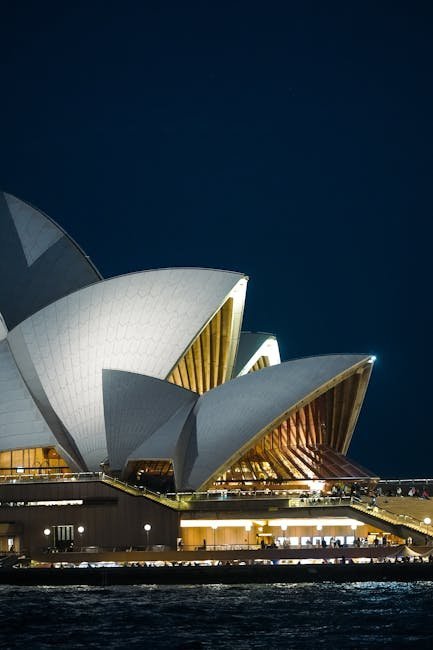
The Sydney Opera House is one of the most recognizable buildings in the world and a masterpiece of 20th-century architecture. Its sail-like shells, rising from Bennelong Point on Sydney Harbour, have become the symbol of Australia itself.
The building was the result of an international design competition in 1956, won by Danish architect Jorn Utzon, then virtually unknown. Utzon's entry consisted of simple sketches showing dramatic shell forms sheltering performance spaces on a prominent harbor site.
Utzon was inspired by the Mayan temples of Central America, which he had visited, and the idea of a raised platform with soaring forms above. The shells were not initially conceived as spheres but as free-form sculptures.
The Engineering Challenge
The shell forms presented unprecedented engineering challenges. Utzon's initial designs were based on parabolic curves, but it proved impossible to develop a cost-effective way to build these irregular shapes. After years of struggle, the breakthrough came when Utzon realized the shells could be derived from the surface of a single sphere.
By using spherical geometry, all the shell segments could be precast from the same spherical radius and assembled on site. This discovery made the project feasible. The shells are composed of ribs of precast concrete, each a segment of a sphere with a radius of about 75 meters.
The shells are clad in over one million ceramic tiles, manufactured in Sweden. The tiles have a matte off-white surface that reflects the changing light of Sydney Harbour. The glossy white tiles at the edges create a striking contrast and define the shell profiles.
The Construction Saga
The construction of the Opera House was a political and financial drama that stretched over 14 years. The original cost estimate was $7 million and the completion date 1963. The actual cost was $102 million and completion was 1973. The project was funded by a state lottery.
Utzon resigned from the project in 1966 after a dispute with the new state government over budgets and control. He left Australia and never returned. His departure was a national tragedy, and the interior completion was entrusted to other architects, who simplified Utzon's designs.
The Opera House was finally opened by Queen Elizabeth II on October 20, 1973, without Utzon present. He was not invited. It was not until 1999 that Utzon was re-engaged to develop a set of design principles for future modifications, and in 2004, the Utzon Room was completed to his original design.
Performance & Legacy
The Sydney Opera House comprises multiple performance venues: the Concert Hall (seating 2,679), the Joan Sutherland Theatre (opera and ballet, 1,507), the Drama Theatre, the Playhouse, and the Studio. Together, they host over 1,800 performances annually.
The Opera House was inscribed on the UNESCO World Heritage List in 2007, one of the few buildings by a living architect to receive this distinction. The citation describes it as 'a great architectural work of the 20th century that brings together multiple strands of creativity and innovation.'
The Opera House continues to evolve. Major renovations in the 2010s and 2020s have improved accessibility, acoustics, and backstage facilities while respecting Utzon's original vision. The building remains Australia's most visited tourist attraction and its most potent cultural symbol.
"The Sydney Opera House is a work of architecture that belongs to the entire world, a building that could only have been conceived in the mid-20th century but will be admired for centuries to come."
Further Reading
Learn more about the Sydney Opera House on Wikipedia and explore broader Western architecture traditions.


The Vision on Bennelong Point
The Sydney Opera House is one of the most recognizable buildings in the world and a masterpiece of 20th-century architecture. Its sail-like shells, rising from Bennelong Point on Sydney Harbour, have become the symbol of Australia itself.
The building was the result of an international design competition in 1956, won by Danish architect Jorn Utzon, then virtually unknown. Utzon's entry consisted of simple sketches showing dramatic shell forms sheltering performance spaces on a prominent harbor site.
Utzon was inspired by the Mayan temples of Central America, which he had visited, and the idea of a raised platform with soaring forms above. The shells were not initially conceived as spheres but as free-form sculptures.
The Engineering Challenge
The shell forms presented unprecedented engineering challenges. Utzon's initial designs were based on parabolic curves, but it proved impossible to develop a cost-effective way to build these irregular shapes. After years of struggle, the breakthrough came when Utzon realized the shells could be derived from the surface of a single sphere.
By using spherical geometry, all the shell segments could be precast from the same spherical radius and assembled on site. This discovery made the project feasible. The shells are composed of ribs of precast concrete, each a segment of a sphere with a radius of about 75 meters.
The shells are clad in over one million ceramic tiles, manufactured in Sweden. The tiles have a matte off-white surface that reflects the changing light of Sydney Harbour. The glossy white tiles at the edges create a striking contrast and define the shell profiles.
The Construction Saga
The construction of the Opera House was a political and financial drama that stretched over 14 years. The original cost estimate was $7 million and the completion date 1963. The actual cost was $102 million and completion was 1973. The project was funded by a state lottery.
Utzon resigned from the project in 1966 after a dispute with the new state government over budgets and control. He left Australia and never returned. His departure was a national tragedy, and the interior completion was entrusted to other architects, who simplified Utzon's designs.
The Opera House was finally opened by Queen Elizabeth II on October 20, 1973, without Utzon present. He was not invited. It was not until 1999 that Utzon was re-engaged to develop a set of design principles for future modifications, and in 2004, the Utzon Room was completed to his original design.
Performance & Legacy
The Sydney Opera House comprises multiple performance venues: the Concert Hall (seating 2,679), the Joan Sutherland Theatre (opera and ballet, 1,507), the Drama Theatre, the Playhouse, and the Studio. Together, they host over 1,800 performances annually.
The Opera House was inscribed on the UNESCO World Heritage List in 2007, one of the few buildings by a living architect to receive this distinction. The citation describes it as 'a great architectural work of the 20th century that brings together multiple strands of creativity and innovation.'
The Opera House continues to evolve. Major renovations in the 2010s and 2020s have improved accessibility, acoustics, and backstage facilities while respecting Utzon's original vision. The building remains Australia's most visited tourist attraction and its most potent cultural symbol.
"The Sydney Opera House is a work of architecture that belongs to the entire world, a building that could only have been conceived in the mid-20th century but will be admired for centuries to come."
The Design and Construction of the Sydney Opera House
The Sydney Opera House design was the result of an international competition in 1956 that attracted 233 entries from architects around the world. The winning submission, by Danish architect Jorn Utzon, was initially almost rejected — the judging panel's decision was controversial because Utzon's sketches were more conceptual than technical, presenting a poetic vision without detailed engineering solutions. Utzon's design was inspired by the billowing sails of Sydney Harbor yachts, orange segments, and the shape of a spherical section. Despite the technical uncertainties, the boldness and originality of the concept captured the imagination of the jury and the public, setting in motion one of the most challenging and transformative construction projects in architectural history.
The engineering of the Opera House's distinctive shell roofs presented unprecedented challenges that pushed the boundaries of architectural mathematics. Utzon eventually solved the shell geometry by realizing that all fourteen shells could be derived from the surface of a single imaginary sphere — a breakthrough that allowed the complex curves to be designed, prefabricated, and assembled with precision. Each shell is composed of concrete ribs covered with ceramic tiles, with the ribs cast on site in specially constructed formwork. The solution was so elegant that the roof tiles could be prefabricated in large triangular panels, dramatically reducing on-site construction time. This geometric insight saved the project from the cost overruns and delays that had plagued its early years.
The ceramic tile cladding of the Opera House's shells is one of its most distinctive features, creating the gleaming white appearance that has become synonymous with Sydney's identity. Over one million tiles, manufactured in Sweden, cover the shells' surface, with two distinct finishes: glossy white tiles on the convex surfaces and matte cream tiles on the concave undersides. This combination creates a subtle play of light that makes the shells appear to glow at different intensities throughout the day. The tiles are self-cleaning to a remarkable degree — Sydney's occasional rain showers wash away accumulated dust, maintaining the shells' brilliant appearance with minimal human intervention.
The interior of the Sydney Opera House is as carefully considered as its iconic exterior, with Utzon designing every detail to enhance the experience of performance. The principal performance halls — the Concert Hall and the Joan Sutherland Theatre — feature acoustics that rank among the world's finest, achieved through carefully shaped ceiling reflectors, adjustable acoustic curtains, and the warm, resonant qualities of the interior finishes. The glass walls of the foyers offer panoramic harbor views, creating intermissions that are as memorable as the performances themselves. Utzon's design ensures that the experience of attending a performance at the Opera House begins not when the curtain rises but when the visitor first enters the building.
Jorn Utzon's relationship with the Opera House project ended tragically when he resigned in 1966 following a dispute with the New South Wales government over costs and timelines. He left Australia permanently, never seeing his masterpiece completed. The interior finishes were substantially completed by a team of local architects, who made decisions that Utzon might not have approved. Despite this difficult history, Utzon was eventually reconciled with the Opera House, accepting a commission in 1999 to develop design principles for future renovations and a renovation of the Reception Hall. He was awarded the Pritzker Prize in 2003, and the Opera House was inscribed on the UNESCO World Heritage List in 2007 — a rare honor for a building less than forty years old.
The Sydney Opera House is one of the most recognizable buildings of the 20th century. Danish architect Jorn Utzon won the international competition in 1957 with sketches more concept than buildable design. Construction was plagued by cost overruns, ballooning from 7 million to 102 million Australian dollars. Utzon resigned in 1966 after a dispute with the government and never saw his masterpiece completed. Despite the controversy, the sail-like shells have become a symbol of Australia.
The engineering of the Sydney Opera House shells was one of the most complex structural challenges of the 20th century. Utzon original design sketches showed sweeping parabolic shells, but extensive analysis revealed that paraboloids could not be built economically with the available construction technology. The breakthrough came when Utzon and engineer Ove Arup realized that the shells could be formed from segments of a single sphere, allowing each section to be cast in a single mold. The spheres have a radius of 75 meters, and the geometry of each shell segment is defined by the intersection of the sphere with a series of vertical planes. This ingenious geometric solution made the construction feasible, though it remained enormously challenging and expensive.
The Sydney Opera House contains five performance venues, including the Concert Hall, which seats 2,679 people and houses the Sydney Symphony Orchestra. The Opera Theatre, with 1,507 seats, is the home of Opera Australia and the Australian Ballet. The buildings acoustics were initially criticized, leading to a major renovation of the Concert Hall completed in 2022 that improved sound quality and accessibility. The Opera House was inscribed on the UNESCO World Heritage List in 2007, recognized as a masterpiece of 20th-century architecture. UNESCOS citation describes the building as a great architectural work of the 20th century that brings together multiple strands of creativity and innovation in both architectural form and structural design. The building continues to inspire architects and engineers, and its image remains one of the most recognizable in the world.