The Flavian Amphitheater
The Colosseum, originally called the Flavian Amphitheater, is the largest ancient amphitheater ever built and one of the greatest works of Roman engineering. Construction began under Emperor Vespasian in 72 CE and was completed under his son Titus in 80 CE.
The building was built on the site of Nero's private lake, draining the water to create a stable foundation. The location was symbolically important: returning the prime real estate of central Rome from imperial luxury to public use.
The Colosseum could hold an estimated 50,000 to 80,000 spectators. The elliptical design (189 meters long, 156 meters wide) ensured that every seat had a good view of the arena floor. The audience was strictly segregated by social class, with the best seats reserved for senators and the vestal virgins.
Engineering Innovations
The Colosseum's structure is a masterwork of Roman concrete construction. The exterior wall, originally clad in travertine marble, consists of three tiers of arched openings framed by engaged columns: Tuscan on the ground level, Ionic on the second, and Corinthian on the third.
The interior was organized by an elaborate system of corridors, staircases, and entrance passages called vomitoria. The 80 entrance arches allowed the entire audience to enter and exit within minutes, a circulation system that modern sports stadiums still use.
The arena floor was a wooden structure covered with sand, supported by an elaborate system of underground chambers, ramps, and elevators called the hypogeum. This two-story underground complex housed gladiators, animals, and stage machinery, with trap doors and elevators allowing dramatic appearances in the arena.
The Velarium
The Colosseum had a retractable awning called the velarium that protected spectators from sun and rain. The velarium was a massive canvas canopy covering the entire seating area, operated by a team of sailors from the Roman navy who had the skills to handle the complex rope system.
The velarium was supported by 240 masts set into brackets on the top of the exterior wall, extending outward from the top tier. The canvas was rigged like a ship's sail, with ropes and pulleys allowing it to be adjusted according to the sun's position.
The velarium was an extraordinary feat of engineering logistics. The canvas alone weighed many tons, and the rope system required precise coordination to operate. Its existence demonstrates the Roman genius for large-scale temporary structures.
After Antiquity
The Colosseum was damaged by the great earthquake of 1349, which caused the collapse of the south side. In subsequent centuries, the building was used as a quarry for building materials. The marble cladding was removed for use in St. Peter's Basilica and other buildings.
It was only in the 18th century that the Colosseum was protected as a Christian site, commemorating the Christians who were martyred there (though the historical evidence for large-scale Christian martyrdom in the Colosseum is limited).
Today, the Colosseum is one of the most popular tourist attractions in the world, receiving over 7 million visitors annually. Recent restoration projects have cleaned the exterior, revealing the original colors of the travertine stone and the traces of painted decoration.
"While the Colosseum stands, Rome shall stand; when the Colosseum falls, Rome shall fall; when Rome falls, the world shall fall."
Further Reading
Learn more about the Colosseum on Wikipedia and explore broader Western architecture traditions.

The Flavian Amphitheater
The Colosseum, originally called the Flavian Amphitheater, is the largest ancient amphitheater ever built and one of the greatest works of Roman engineering. Construction began under Emperor Vespasian in 72 CE and was completed under his son Titus in 80 CE.
The building was built on the site of Nero's private lake, draining the water to create a stable foundation. The location was symbolically important: returning the prime real estate of central Rome from imperial luxury to public use.
The Colosseum could hold an estimated 50,000 to 80,000 spectators. The elliptical design (189 meters long, 156 meters wide) ensured that every seat had a good view of the arena floor. The audience was strictly segregated by social class, with the best seats reserved for senators and the vestal virgins.
Engineering Innovations
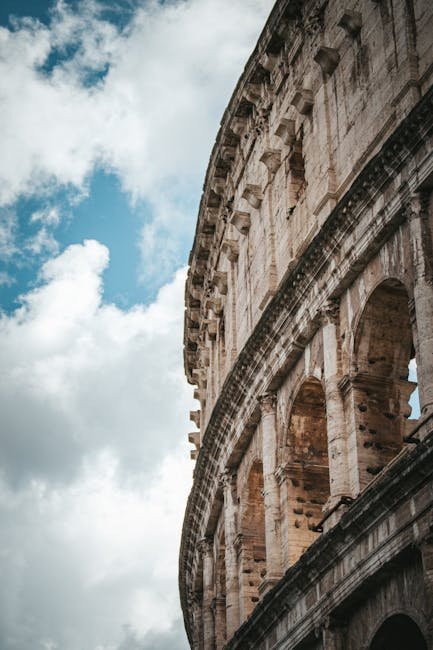
The Colosseum's structure is a masterwork of Roman concrete construction. The exterior wall, originally clad in travertine marble, consists of three tiers of arched openings framed by engaged columns: Tuscan on the ground level, Ionic on the second, and Corinthian on the third.
The interior was organized by an elaborate system of corridors, staircases, and entrance passages called vomitoria. The 80 entrance arches allowed the entire audience to enter and exit within minutes, a circulation system that modern sports stadiums still use.
The arena floor was a wooden structure covered with sand, supported by an elaborate system of underground chambers, ramps, and elevators called the hypogeum. This two-story underground complex housed gladiators, animals, and stage machinery, with trap doors and elevators allowing dramatic appearances in the arena.
The Velarium
The Colosseum had a retractable awning called the velarium that protected spectators from sun and rain. The velarium was a massive canvas canopy covering the entire seating area, operated by a team of sailors from the Roman navy who had the skills to handle the complex rope system.
The velarium was supported by 240 masts set into brackets on the top of the exterior wall, extending outward from the top tier. The canvas was rigged like a ship's sail, with ropes and pulleys allowing it to be adjusted according to the sun's position.
The velarium was an extraordinary feat of engineering logistics. The canvas alone weighed many tons, and the rope system required precise coordination to operate. Its existence demonstrates the Roman genius for large-scale temporary structures.
After Antiquity
The Colosseum was damaged by the great earthquake of 1349, which caused the collapse of the south side. In subsequent centuries, the building was used as a quarry for building materials. The marble cladding was removed for use in St. Peter's Basilica and other buildings.
It was only in the 18th century that the Colosseum was protected as a Christian site, commemorating the Christians who were martyred there (though the historical evidence for large-scale Christian martyrdom in the Colosseum is limited).
Today, the Colosseum is one of the most popular tourist attractions in the world, receiving over 7 million visitors annually. Recent restoration projects have cleaned the exterior, revealing the original colors of the travertine stone and the traces of painted decoration.
"While the Colosseum stands, Rome shall stand; when the Colosseum falls, Rome shall fall; when Rome falls, the world shall fall."
Roman Engineering Marvels of the Colosseum
The Colosseum's structural engineering was astonishingly sophisticated for the first century AD, employing construction techniques that would not be surpassed for over a millennium. The elliptical amphitheater measures 189 meters long and 156 meters wide, with a height of 48 meters — equivalent to a modern sixteen-story building. The outer wall, originally clad in travertine marble held together by iron clamps rather than mortar, consisted of three tiers of arched openings framed by engaged columns of the Doric, Ionic, and Corinthian orders, crowned by an attic story with Corinthian pilasters. Each of the eighty arches served as a numbered entrance, allowing the efficient circulation of up to 50,000 spectators — a system of crowd management that modern stadium designers still study.
The Colosseum's retractable awning system, known as the velarium, was one of ancient Rome's most impressive engineering achievements. This massive canvas canopy, covering the entire elliptical seating area to protect spectators from sun and rain, was operated by a dedicated team of sailors from the Roman fleet who applied their knowledge of rigging and sails to the task. The velarium was supported by a complex system of masts and ropes anchored to corbels on the exterior wall's top story, with counterweights and pulleys that allowed the canopy to be extended or retracted as weather conditions changed. This system's scale and sophistication demonstrate that Roman engineering expertise extended far beyond the structural frame of the building itself.
The hypogeum, or underground network of tunnels and chambers beneath the Colosseum's arena floor, reveals the building's function as a sophisticated theatrical machine. This two-story subterranean complex contained animal cages, gladiator holding cells, scenery storage, and mechanical elevators that could lift animals, performers, and stage sets directly into the arena through trap doors. Thirty-two vertical shafts connected to a network of winches and pulleys, operated by a workforce of slaves and laborers hidden from the audience's view. The hypogeum's complex logistics allowed for rapid scene changes and dramatic reveals — wild beasts could appear to materialize in the arena, and elaborate stage sets could be assembled and disassembled with remarkable speed.
The Colosseum's drainage system was equally impressive, designed to handle both rainwater and the water used in mock naval battles (naumachiae) staged during the building's early years. A network of drains beneath the hypogeum channeled water away from the structure, while the arena floor could be flooded to a depth sufficient for small ships to maneuver. Although the naumachiae were eventually discontinued as the hypogeum was built over the arena floor, the drainage infrastructure remained functional for centuries, testament to the thoroughness of Roman engineering. The Colosseum also incorporated sophisticated water features and fountains throughout its seating areas, providing refreshment for spectators during long days of entertainment.
The Colosseum's destruction and transformation over the centuries is as remarkable as its construction. Severe earthquakes in 847 and 1231 caused large sections of the outer wall to collapse, and for centuries afterward, the Colosseum served as a convenient quarry for building materials — its travertine marble was reused in St. Peter's Basilica, the Palazzo Venezia, and countless other Roman structures. Despite this systematic dismantling, approximately two-thirds of the original structure remains standing, a testament to the quality of Roman concrete and engineering. The Colosseum was declared a UNESCO World Heritage Site in 1980 and has undergone extensive restoration in recent decades, including a major cleaning and stabilization project funded by the Italian fashion house Tod's.
The Colosseum, the largest ancient amphitheater ever built, remains the iconic symbol of Imperial Rome. Construction began under Vespasian in 72 AD and was completed under Titus in 80 AD. The structure could hold up to 80,000 spectators who entered through 80 numbered entrances - a crowd management system unrivaled until the 20th century. The hypogeum, a two-level underground network, housed animals and stage machinery for elaborate spectacles.
The Colosseum has suffered extensively from natural disasters and human depredation over its two millennia of existence. A major earthquake in 847 AD caused the collapse of the southern side of the outer wall, and subsequent earthquakes caused further damage. Throughout the Middle Ages and Renaissance, the Colosseum was used as a quarry for building materials, with its stone and marble removed for use in other Roman buildings including St Peters Basilica and the Palazzo Venezia. Despite this extensive damage, the Colosseum remains remarkably intact, and its essential architectural character is still clearly legible.
Today the Colosseum is one of the most popular tourist attractions in the world, receiving over 7 million visitors annually. Recent restoration efforts have focused on cleaning and stabilizing the structure, removing vegetation that was damaging the ancient masonry, and reinforcing the remaining fabric against future earthquakes. The Colosseum was used as a symbol of opposition to the death penalty in 1999, when the city of Rome changed the color of the night lighting from white to gold whenever a death sentence was commuted or a prisoner was released. This tradition continues today, connecting the ancient amphitheater to contemporary human rights advocacy and giving new meaning to a monument that was once a site of death and suffering.
The Colosseum's construction employed Roman concrete (opus caementicium) in remarkably sophisticated ways for the first century AD. The concrete used in foundations and lower levels contained volcanic ash from Pozzuoli near Naples, which created a chemical reaction allowing the concrete to set underwater and achieve exceptional longevity. The vaulted corridors and passages encircling the amphitheater used lightweight volcanic pumice as aggregate in the concrete mix, reducing the weight of upper structures while maintaining strength. Modern materials scientists have studied the self-healing properties of Roman concrete — the formation of calcium-aluminum-silicate-hydrate minerals within micro-cracks over time — which has inspired development of more durable modern concretes. The Colosseum thus serves not only as a monument to ancient engineering but as an active research site for contemporary materials science, with lessons from Roman methods informing more sustainable building materials.