Gaudi's Life Work
The Basílica de la Sagrada Familia in Barcelona is Antoni Gaudi's masterwork and the most famous unfinished building in the world. Gaudi took over the project in 1883, a year after construction began under architect Francisco de Paula del Villar. He devoted the last 43 years of his life to the project.
Gaudi knew the church would not be completed in his lifetime. He famously said, 'My client is not in a hurry.' As he aged, he became increasingly focused on the project, living on site and finally moving his studio into the church itself. When he died in 1926, less than a quarter of the building was complete.
The Sagrada Familia combines late Gothic and Art Nouveau forms in a uniquely personal synthesis. Gaudi's architecture is organic, inspired by natural forms, and structurally innovative. The building's design evolved continuously as Gaudi worked, often changing details based on observation of construction progress.
Structural Innovation
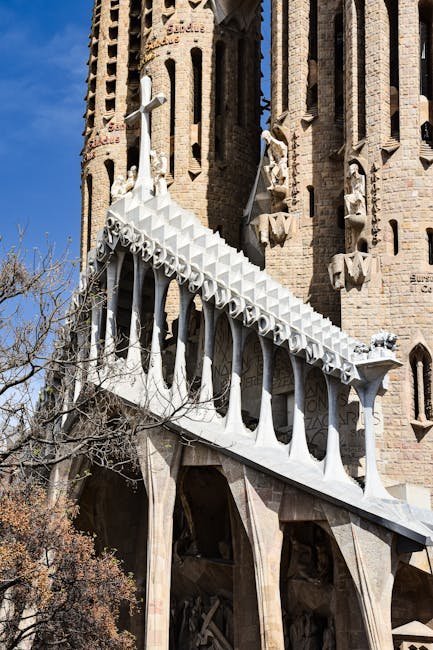
Gaudi developed an entirely original structural system for the Sagrada Familia. Instead of the flying buttresses used in Gothic cathedrals, he used inclined columns that branch like trees at the top. The columns' angles are calculated to channel the weight of the roof directly to the ground.
The church uses hyperbolic paraboloid and hyperboloid surfaces throughout, shapes that are both structurally efficient and aesthetically striking. These doubly curved surfaces are stronger and lighter than traditional vaulting. The column capitals are hyperboloids, merging seamlessly into the branching structure.
Gaudi created inverted model using weighted strings to calculate the optimal shape for the church's vaults. This funicular model, now preserved in the museum, demonstrates Gaudi's intuitive understanding of structural forces. Shapes determined by gravity in the model were inverted to create the actual building forms.
The Three Facades
The Sagrada Familia has three grand facades, each representing a key moment in Christ's life. The Nativity Facade, built during Gaudi's lifetime, celebrates the birth of Jesus with exuberant naturalistic sculpture. It is the most directly Gaudi-designed portion of the church.
The Passion Facade, completed later, depicts the crucifixion with stark, angular sculptures by Josep Maria Subirachs. Its severe, bone-like forms intentionally contrast with the lush Nativity Facade. The facade includes a magic square of numbers that always sum to 33, the age of Christ at his death.
The Glory Facade, still under construction, will be the largest and most dramatic. It will depict the ultimate destiny of humanity, with scenes of heaven and hell. The facade is oriented toward the rising sun and will feature a grand staircase leading to the entrance.
The Towers
The completed church will have 18 towers representing religious figures: 12 for the apostles, 4 for the evangelists, one for the Virgin Mary, and the tallest for Jesus Christ. The central Jesus tower will reach 172.5 meters, making the Sagrada Familia the tallest church in the world.
Gaudi deliberately designed the Jesus tower to be one meter shorter than Montjuic hill, saying that human creation should not surpass God's creation. The towers are topped with symbolic elements: the apostles' towers with Venetian-style mosaics and the evangelists' towers with their symbols.
The church is expected to finally be completed in 2026, the centenary of Gaudi's death, though the date remains uncertain. The completion will be the culmination of over 140 years of continuous construction, making the Sagrada Familia the longest-running architectural project in history.
"The Sagrada Familia is a work that is in the hands of God and the will of the people. It is not a building but a prayer in stone, growing organically through generations of faith and craft."
Further Reading
Learn more about the Sagrada Familia on Wikipedia and explore broader Western architecture traditions.
Gaudi's Life Work
The Basílica de la Sagrada Familia in Barcelona is Antoni Gaudi's masterwork and the most famous unfinished building in the world. Gaudi took over the project in 1883, a year after construction began under architect Francisco de Paula del Villar. He devoted the last 43 years of his life to the project.
Gaudi knew the church would not be completed in his lifetime. He famously said, 'My client is not in a hurry.' As he aged, he became increasingly focused on the project, living on site and finally moving his studio into the church itself. When he died in 1926, less than a quarter of the building was complete.
The Sagrada Familia combines late Gothic and Art Nouveau forms in a uniquely personal synthesis. Gaudi's architecture is organic, inspired by natural forms, and structurally innovative. The building's design evolved continuously as Gaudi worked, often changing details based on observation of construction progress.
Structural Innovation
Gaudi developed an entirely original structural system for the Sagrada Familia. Instead of the flying buttresses used in Gothic cathedrals, he used inclined columns that branch like trees at the top. The columns' angles are calculated to channel the weight of the roof directly to the ground.
The church uses hyperbolic paraboloid and hyperboloid surfaces throughout, shapes that are both structurally efficient and aesthetically striking. These doubly curved surfaces are stronger and lighter than traditional vaulting. The column capitals are hyperboloids, merging seamlessly into the branching structure.
Gaudi created inverted model using weighted strings to calculate the optimal shape for the church's vaults. This funicular model, now preserved in the museum, demonstrates Gaudi's intuitive understanding of structural forces. Shapes determined by gravity in the model were inverted to create the actual building forms.
The Three Facades
The Sagrada Familia has three grand facades, each representing a key moment in Christ's life. The Nativity Facade, built during Gaudi's lifetime, celebrates the birth of Jesus with exuberant naturalistic sculpture. It is the most directly Gaudi-designed portion of the church.
The Passion Facade, completed later, depicts the crucifixion with stark, angular sculptures by Josep Maria Subirachs. Its severe, bone-like forms intentionally contrast with the lush Nativity Facade. The facade includes a magic square of numbers that always sum to 33, the age of Christ at his death.
The Glory Facade, still under construction, will be the largest and most dramatic. It will depict the ultimate destiny of humanity, with scenes of heaven and hell. The facade is oriented toward the rising sun and will feature a grand staircase leading to the entrance.
The Towers
The completed church will have 18 towers representing religious figures: 12 for the apostles, 4 for the evangelists, one for the Virgin Mary, and the tallest for Jesus Christ. The central Jesus tower will reach 172.5 meters, making the Sagrada Familia the tallest church in the world.
Gaudi deliberately designed the Jesus tower to be one meter shorter than Montjuic hill, saying that human creation should not surpass God's creation. The towers are topped with symbolic elements: the apostles' towers with Venetian-style mosaics and the evangelists' towers with their symbols.
The church is expected to finally be completed in 2026, the centenary of Gaudi's death, though the date remains uncertain. The completion will be the culmination of over 140 years of continuous construction, making the Sagrada Familia the longest-running architectural project in history.
"The Sagrada Familia is a work that is in the hands of God and the will of the people. It is not a building but a prayer in stone, growing organically through generations of faith and craft."
Antoni Gaudi's Visionary Architecture for the Sagrada Familia
Antoni Gaudi's architectural approach for the Sagrada Familia was revolutionary, drawing inspiration from the natural world to create a structure that seems organic rather than designed. Gaudi studied the geometry of trees, bones, shells, and waves to develop a structural system that combined breathtaking beauty with engineering efficiency. The basilica's interior columns branch at their capitals like trees in a forest, creating a canopy of stone leaves that supports the ceiling while guiding the eye upward. Gaudi designed these columns to tilt at precise angles to distribute the building's weight in ways that eliminated the need for internal buttresses, creating an open, light-filled interior that feels miraculously weightless.
The Sagrada Familia's facades are a complex narrative of Christian theology told through sculptural stone. The Nativity Facade, completed during Gaudi's lifetime, depicts the birth of Christ with joyful, organic forms reminiscent of a living cave. The Passion Facade, stark and angular, contrasts dramatically with its depiction of Christ's crucifixion through severe, bone-like forms created by sculptor Josep Subiraux in the late twentieth century. The Glory Facade, still under construction, will face the main entrance and depict humanity's relationship with God. Each facade was designed to be read from a distance as a complete composition, with details that reveal themselves progressively as the viewer approaches.
Gaudi's working methods for the Sagrada Familia were as unconventional as the building itself. Rather than creating detailed blueprints, he worked primarily with plaster models that he modified by hand as his vision evolved. He directed construction crews from the building site, often stopping work to adjust details on the spot. In his final years, Gaudi lived in a workshop on the construction site, devoting himself entirely to the project and personally supervising every aspect of the work. He often collected stones, plants, and bones from the surrounding area to use as reference models, believing that nature's forms were the truest expression of divine design.
The construction history of the Sagrada Familia is marked by tragedy, interruption, and eventual renewal. Gaudi died in 1926, struck by a tram and initially unrecognized, with less than a quarter of his great work completed. The destruction of his workshop and plaster models during the Spanish Civil War in 1936 destroyed much of his original documentation, forcing subsequent architects to reconstruct his intentions from fragments and photographs. Despite these setbacks, construction continued through the twentieth century, accelerating significantly in the 1990s with the advent of computer-aided design. The use of digital modeling has allowed architects to analyze and extend Gaudi's original designs with unprecedented accuracy.
The anticipated completion of the Sagrada Familia in the coming decades, nearly 150 years after construction began, will mark the culmination of one of architecture's most extraordinary stories. The current construction pace, accelerated by advanced technology and increased funding from tourism, suggests that the main tower of Jesus Christ, reaching 172.5 meters, will make the Sagrada Familia the tallest religious building in Europe. The completion plan includes eighteen towers representing Christ, the Virgin Mary, the four evangelists, and the twelve apostles, each designed with Gaudi's characteristic integration of form and symbolism. The finished basilica will stand as a testament not only to Gaudi's genius but to the persistence of a vision across generations.
Antoni Gaudi took over the Sagrada Familia project in 1883 and devoted the last 43 years of his life to it. When he died in 1926, less than a quarter was complete. Construction continues today, relying entirely on private donations and ticket sales. Gaudi design synthesizes Gothic and Art Nouveau elements with natural forms. The interior resembles a forest with branching columns. The completed temple will have 18 towers, each dedicated to a biblical figure.
The symbolic program of the Sagrada Familia is extraordinarily rich, with every element of the design carrying meaning. The three grand facades, Nativity, Passion, and Glory, represent the life of Christ and are covered with elaborate sculptural programs. The Nativity Facade, completed during Gaudis lifetime, celebrates birth and life with exuberant organic decoration. The Passion Facade, completed later, is stark and angular, depicting the suffering and death of Christ through dramatic, emotive sculpture. The Glory Facade, still under construction, will represent the path to God through death, judgment, and resurrection. Each of the 18 towers is dedicated to a specific biblical figure: 12 towers for the apostles, 4 for the evangelists, one for the Virgin Mary, and the tallest, reaching 172.5 meters, for Jesus Christ.
The completion of the Sagrada Familia has been a subject of controversy and debate. Critics argue that the project has strayed from Gaudis original vision and that the use of modern construction techniques and materials is inappropriate for a building that Gaudis intended to be a work of traditional craftsmanship. Supporters counter that Gaudis himself expected the building to evolve over time and that the continuation of construction honors his vision of a cathedral built by generations. The use of computer modeling, CNC milling, and 3D printing has accelerated construction and enabled the creation of complex geometric forms that Gaudis could only imagine. The project is now expected to be completed by 2026, the centenary of Gaudis death, though some elements may continue beyond that date. The Sagrada Familia was consecrated as a basilica by Pope Benedict XVI in 2010, recognizing its significance as both a religious and architectural monument.