A Living Palace
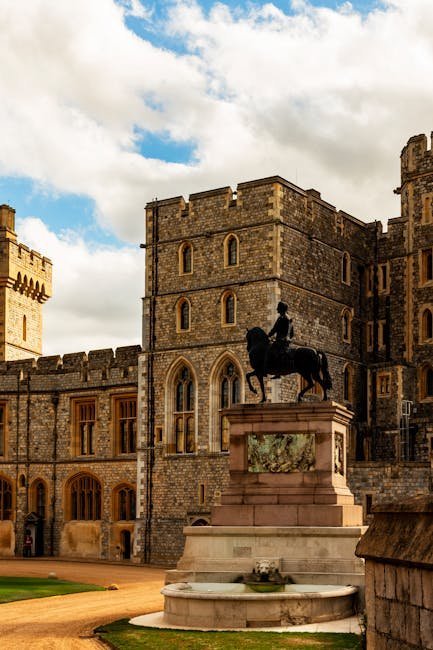
Windsor Castle is the oldest and largest continuously occupied castle in the world. It has been a royal residence for over 900 years, serving as both a private home for the British monarch and an official venue for state occasions. The castle covers approximately 13 acres and sits majestically above the River Thames in Berkshire, England.
What makes Windsor unique among castles is its architectural layering. Every century since the 11th has left its mark on the building. The result is not a pure example of any single style but a living chronicle of English architectural history, from Norman fortifications to Victorian Gothic opulence.
The castle is divided into three distinct sections: the Lower Ward, which contains St George's Chapel; the Middle Ward, dominated by the Round Tower; and the Upper Ward, which contains the State Apartments and the private royal apartments.
The Round Tower & Norman Origins
William the Conqueror began building Windsor Castle around 1070 as part of a ring of defensive fortifications around London. The original structure was a simple motte-and-bailey castle with a wooden keep on an artificial mound. The Round Tower, the iconic central feature of Windsor, was built on this original Norman mound.
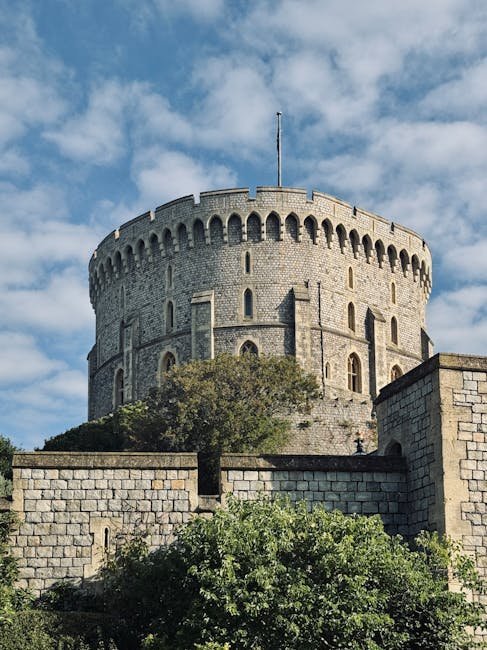
The Round Tower as it appears today was largely reconstructed in the 19th century by architect Jeffry Wyatville, who raised its height and added the distinctive toy-soldier silhouette that now defines the castle's skyline. From the top of the Round Tower, the castle's flag signals whether the monarch is in residence: the Royal Standard flies when present, the Union Jack when absent.
The original Norman fortifications were gradually replaced in stone over the following centuries. Henry II replaced the wooden palisade with stone walls, and Henry III built the first royal apartments. The castle's defensive function was tested during the Barons' War and the English Civil War, when it was held by Parliamentary forces.
St George's Chapel
St George's Chapel is one of the finest examples of Perpendicular Gothic architecture in England. Built between 1475 and 1528 by Kings Edward IV and Henry VII, it serves as the chapel of the Order of the Garter, the oldest order of chivalry in Britain, founded by Edward III in 1348.
The chapel's fan-vaulted ceiling is a masterpiece of English medieval masonry. The stone seems to float, spreading outward like palm fronds from slender pillars. The chapel contains the carved wooden stalls of the Garter Knights, each marked by the knight's heraldic banner, crest, and coat of arms.
St George's Chapel has been the site of royal weddings, including that of Prince Harry and Meghan Markle in 2018, and royal funerals. Several monarchs are buried here, including Henry VIII, Charles I, and George VI, the father of Queen Elizabeth II. The Queen herself was buried here in 2022.
The State Apartments
The State Apartments at Windsor contain some of the finest interiors in Britain. They were extensively remodeled in the 17th century for Charles II, who created a Baroque suite of rooms modeled on Louis XIV's Versailles. The ceilings were painted by the Venetian artist Antonio Verrio, and the woodcarvings were executed by Grinling Gibbons.
After a devastating fire in 1992 that damaged over 100 rooms, the State Apartments were meticulously restored using traditional crafts and techniques. The restoration project, completed in 1997, was a landmark achievement in historic building preservation, reviving skills like gilding, plasterwork, and stone carving that had become rare.
The Semi-State Apartments, created by George IV in the 1820s, are among the most opulent rooms in the castle. The Crimson Drawing Room, the Green Drawing Room, and the State Dining Room are furnished with treasures from the Royal Collection, including paintings by Rembrandt, Rubens, and Canaletto.
The Great Park & Changing of the Guard
Windsor's setting within the 5,000-acre Windsor Great Park is integral to its character. The park includes ancient woodland, the Long Walk (a three-mile avenue of trees leading to the castle), and the Savill Garden, one of the finest ornamental gardens in Britain.
The Changing of the Guard at Windsor Castle is a spectacle of British pageantry. The Queen's Guard marches through the castle grounds accompanied by a military band, performing the same ceremony that has taken place for centuries. The ceremony usually begins at 11:00 AM and is free to watch with castle admission.
"Windsor Castle is not a building but a living history of England, each stone laid by a different hand, each room shaped by a different reign, yet all united by the continuous thread of monarchy."
Further Reading
Learn more about Windsor Castle on Wikipedia and explore broader Western architecture traditions.
Architectural Evolution of Windsor Castle
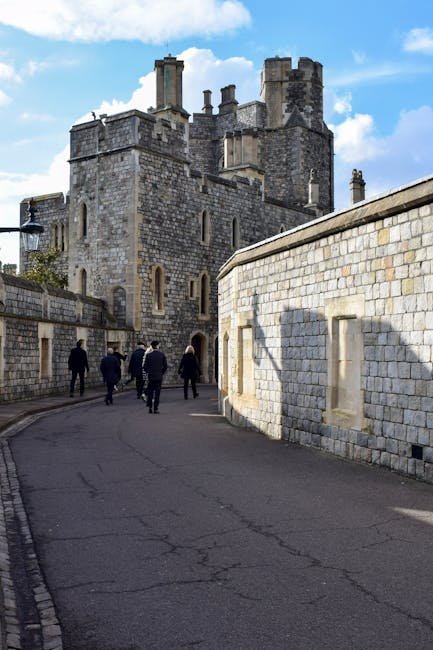
Windsor Castle has undergone continuous architectural transformation over its 900-year history. The Round Tower, the most prominent feature of the castle's silhouette, was originally a 12th-century Norman keep. It was raised to its current height in the 19th century by architect Jeffry Wyatville, who gave the castle its picturesque Gothic silhouette. Wyatville's remodeling transformed Windsor from an irregular medieval fortress into the romantic castle we see today, with towers, battlements, and pointed windows creating a unified Gothic composition.
St George's Chapel (1475-1528) is one of the finest examples of Perpendicular Gothic architecture in England. Its fan-vaulted ceiling, the largest of its kind in the world, creates a stone canopy of extraordinary delicacy. The chapel is the spiritual home of the Order of the Garter, the oldest order of chivalry in England, founded by Edward III in 1348. The chapel's stalls are adorned with the heraldic banners of the Knights of the Garter, creating a permanent display of British aristocratic heraldry.
The State Apartments at Windsor represent the evolution of royal interior decoration from the 17th century to the present. The Grand Reception Room, the Waterloo Chamber, and the Crimson Drawing Room are decorated with works by Rubens, Van Dyck, Canaletto, and Holbein. The castle's art collection is one of the most important in the world, and the interiors have been adapted over centuries to suit changing tastes while preserving the accumulated richness of earlier periods.
The fire of 1992, which destroyed nine State Rooms, led to the most extensive restoration project in the castle's history. The restoration, completed in 1997, was a masterwork of architectural conservation. Damaged rooms were meticulously reconstructed using traditional materials and techniques, while some spaces were redesigned in a more contemporary idiom. The new ceiling of St George's Hall, a fan-vaulted structure in green oak, demonstrated that traditional craftsmanship could continue to produce work of the highest quality.
A Living Palace
Windsor Castle is the oldest and largest continuously occupied castle in the world. It has been a royal residence for over 900 years, serving as both a private home for the British monarch and an official venue for state occasions. The castle covers approximately 13 acres and sits majestically above the River Thames in Berkshire, England.
What makes Windsor unique among castles is its architectural layering. Every century since the 11th has left its mark on the building. The result is not a pure example of any single style but a living chronicle of English architectural history, from Norman fortifications to Victorian Gothic opulence.
The castle is divided into three distinct sections: the Lower Ward, which contains St George's Chapel; the Middle Ward, dominated by the Round Tower; and the Upper Ward, which contains the State Apartments and the private royal apartments.
The Round Tower & Norman Origins
William the Conqueror began building Windsor Castle around 1070 as part of a ring of defensive fortifications around London. The original structure was a simple motte-and-bailey castle with a wooden keep on an artificial mound. The Round Tower, the iconic central feature of Windsor, was built on this original Norman mound.
The Round Tower as it appears today was largely reconstructed in the 19th century by architect Jeffry Wyatville, who raised its height and added the distinctive toy-soldier silhouette that now defines the castle's skyline. From the top of the Round Tower, the castle's flag signals whether the monarch is in residence: the Royal Standard flies when present, the Union Jack when absent.
The original Norman fortifications were gradually replaced in stone over the following centuries. Henry II replaced the wooden palisade with stone walls, and Henry III built the first royal apartments. The castle's defensive function was tested during the Barons' War and the English Civil War, when it was held by Parliamentary forces.
St George's Chapel
St George's Chapel is one of the finest examples of Perpendicular Gothic architecture in England. Built between 1475 and 1528 by Kings Edward IV and Henry VII, it serves as the chapel of the Order of the Garter, the oldest order of chivalry in Britain, founded by Edward III in 1348.
The chapel's fan-vaulted ceiling is a masterpiece of English medieval masonry. The stone seems to float, spreading outward like palm fronds from slender pillars. The chapel contains the carved wooden stalls of the Garter Knights, each marked by the knight's heraldic banner, crest, and coat of arms.
St George's Chapel has been the site of royal weddings, including that of Prince Harry and Meghan Markle in 2018, and royal funerals. Several monarchs are buried here, including Henry VIII, Charles I, and George VI, the father of Queen Elizabeth II. The Queen herself was buried here in 2022.
The State Apartments
The State Apartments at Windsor contain some of the finest interiors in Britain. They were extensively remodeled in the 17th century for Charles II, who created a Baroque suite of rooms modeled on Louis XIV's Versailles. The ceilings were painted by the Venetian artist Antonio Verrio, and the woodcarvings were executed by Grinling Gibbons.
After a devastating fire in 1992 that damaged over 100 rooms, the State Apartments were meticulously restored using traditional crafts and techniques. The restoration project, completed in 1997, was a landmark achievement in historic building preservation, reviving skills like gilding, plasterwork, and stone carving that had become rare.
The Semi-State Apartments, created by George IV in the 1820s, are among the most opulent rooms in the castle. The Crimson Drawing Room, the Green Drawing Room, and the State Dining Room are furnished with treasures from the Royal Collection, including paintings by Rembrandt, Rubens, and Canaletto.
The Great Park & Changing of the Guard
Windsor's setting within the 5,000-acre Windsor Great Park is integral to its character. The park includes ancient woodland, the Long Walk (a three-mile avenue of trees leading to the castle), and the Savill Garden, one of the finest ornamental gardens in Britain.
The Changing of the Guard at Windsor Castle is a spectacle of British pageantry. The Queen's Guard marches through the castle grounds accompanied by a military band, performing the same ceremony that has taken place for centuries. The ceremony usually begins at 11:00 AM and is free to watch with castle admission.
"Windsor Castle is not a building but a living history of England, each stone laid by a different hand, each room shaped by a different reign, yet all united by the continuous thread of monarchy."
Architectural Evolution of Windsor Castle
Windsor Castle has undergone continuous architectural transformation over its 900-year history. The Round Tower, the most prominent feature of the castle's silhouette, was originally a 12th-century Norman keep. It was raised to its current height in the 19th century by architect Jeffry Wyatville, who gave the castle its picturesque Gothic silhouette. Wyatville's remodeling transformed Windsor from an irregular medieval fortress into the romantic castle we see today, with towers, battlements, and pointed windows creating a unified Gothic composition.
St George's Chapel (1475-1528) is one of the finest examples of Perpendicular Gothic architecture in England. Its fan-vaulted ceiling, the largest of its kind in the world, creates a stone canopy of extraordinary delicacy. The chapel is the spiritual home of the Order of the Garter, the oldest order of chivalry in England, founded by Edward III in 1348. The chapel's stalls are adorned with the heraldic banners of the Knights of the Garter, creating a permanent display of British aristocratic heraldry.
The State Apartments at Windsor represent the evolution of royal interior decoration from the 17th century to the present. The Grand Reception Room, the Waterloo Chamber, and the Crimson Drawing Room are decorated with works by Rubens, Van Dyck, Canaletto, and Holbein. The castle's art collection is one of the most important in the world, and the interiors have been adapted over centuries to suit changing tastes while preserving the accumulated richness of earlier periods.
The fire of 1992, which destroyed nine State Rooms, led to the most extensive restoration project in the castle's history. The restoration, completed in 1997, was a masterwork of architectural conservation. Damaged rooms were meticulously reconstructed using traditional materials and techniques, while some spaces were redesigned in a more contemporary idiom. The new ceiling of St George's Hall, a fan-vaulted structure in green oak, demonstrated that traditional craftsmanship could continue to produce work of the highest quality.
Windsor Castle Through the Centuries
Windsor Castle's nine centuries of continuous royal occupation make it unique among European palaces, offering an unparalleled living record of monarchical and architectural history. Originally built by William the Conqueror around 1070 as a motte-and-bailey fortification, the castle was strategically positioned on a chalk bluff above the River Thames to guard the western approach to London. Its location near Windsor Forest, a royal hunting ground, also made it a convenient residence for Norman kings who prized the chase. The castle has been continuously modified and expanded by successive monarchs, each leaving their architectural mark while respecting the essential character of the original fortress.
The transformation of Windsor into a Gothic masterpiece largely reflects the vision of George IV and his architect Jeffry Wyatville in the 1820s. The Round Tower was raised by thirty feet to create a more dramatic silhouette, while the State Apartments were remodeled in a spectacular Gothic Revival style. The Waterloo Chamber, built to commemorate the defeat of Napoleon, houses portraits of Allied sovereigns and commanders, forming one of the most remarkable collections of state portraiture in the world. St George's Chapel, founded by Edward IV in 1475, represents the pinnacle of English Perpendicular Gothic architecture and serves as the spiritual heart of the castle, hosting royal weddings and the chivalric ceremonies of the Order of the Garter.
The devastating fire of 1992, which destroyed or damaged over one hundred rooms, became an unexpected opportunity for renewal. The fire broke out in the Private Chapel and spread rapidly through the State Apartments, fueled by the historic building's dry timber and concealed voids. The five-year restoration project that followed was the largest historic building repair in European history, employing traditional craftsmen and techniques alongside modern fire prevention systems. The restored rooms, unveiled in 1997, demonstrated that historic buildings could be authentically repaired while discreetly incorporating contemporary safety standards. Windsor Castle emerged from the disaster not merely restored but enhanced, a testament to the value placed on preserving living history.
Windsor Castle is the largest and oldest inhabited castle in the world, continuously occupied by British monarchs for nearly a thousand years. Founded by William the Conqueror in the 11th century, the castle has been modified by successive monarchs, creating a rich architectural palimpsest spanning the Norman period to the present day.
The castle suffered a devastating fire in 1992 that damaged over 100 rooms. The subsequent restoration, completed in 1997, was a triumph of traditional craftsmanship. St George Chapel within the castle grounds is one of the finest examples of Perpendicular Gothic architecture in England and serves as the spiritual home of the Order of the Garter.
The architecture of Windsor Castle reflects the changing tastes and priorities of English monarchs across a millennium. The original Norman castle consisted of a motte and bailey, with the Round Tower built on the motte and the wards enclosed by curtain walls. Henry II replaced the wooden palisade with stone walls and built the first royal apartments. Henry III added the magnificent St George Chapel in the 13th century. Edward III, born at Windsor, invested heavily in the castle, building the St George Hall and the State Apartments. The castle assumed its current appearance largely through the work of George IV and his architect Jeffry Wyatville in the 1820s, who raised the height of the Round Tower, remodeled the State Apartments in the Gothic style, and gave the castle its picturesque silhouette.
The State Apartments of Windsor Castle are among the most magnificent interiors in Britain. The St George Hall, 55 meters long, is decorated with the coats of arms of Knights of the Garter, the most senior order of British knighthood. The Waterloo Chamber, built to commemorate the defeat of Napoleon, contains portraits of the monarchs, generals, and statesmen involved in the victory. The Grand Reception Room, decorated in the French style with Gobelin tapestries and a coffered ceiling, is used for state occasions. The Semi-State Rooms, damaged in the 1992 fire and restored to their original 19th-century appearance, showcase the virtuosity of modern craftsmen working in historic techniques. The restoration of these rooms, completed at a cost of 37 million, demonstrated the continuing value placed on traditional building crafts and the preservation of historic interiors.