Learning from Las Vegas
Postmodern architecture emerged in the 1970s as a reaction against the austerity and dogmatism of modernism. Its founding text was Robert Venturi's Complexity and Contradiction in Architecture (1966), which argued for a more inclusive, complex architecture that embraced ambiguity and historical reference.
Venturi's Learning from Las Vegas (1972), co-authored with Denise Scott Brown and Steven Izenour, analyzed the commercial strip as a legitimate form of urbanism. The book argued that architects should learn from popular taste and vernacular building rather than imposing elite modernist values.
Postmodernism rejected the modernist mantra of less is more. Venturi countered with less is a bore, advocating for an architecture that was rich, layered, and communicative. The decorated shed, a simple building with a communicative facade, became a Postmodern typology.
Key Postmodern Features
Postmodern buildings are characterized by the return of historical reference, used ironically and out of context. Classical columns, pediments, arches, and moldings reappear, but distorted, fragmented, or combined in unexpected ways. The past is quoted, not faithfully reproduced.
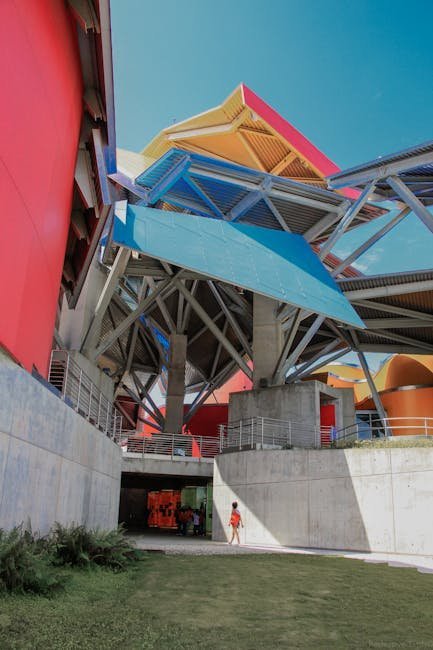
Color returns to architecture after decades of modernist white and gray. Postmodern buildings are often brightly colored, with pastel facades, colored metal panels, and patterned ceramic tiles. The color is playful and decorative, not structural or functional.
Postmodernism embraces ornament as meaningful communication. Friezes, cornices, decorative keystones, and applied architectural elements are used to give buildings visual interest and cultural resonance. The ornament is often overscaled or placed in unexpected positions.
Major Works & Architects
Philip Johnson's AT&T Building in New York (1984), now the Sony Tower, was a watershed Postmodern building. Its granite facade, topped with a Chippendale-style broken pediment, was a deliberate rejection of the glass-box modernist tower. The building announced that postmodernism had arrived in corporate architecture.
Michael Graves's Portland Building (1982) is Postmodernism's most famous civic building. Its blocky form is decorated with applied classical elements in pastel colors. The building was controversial but became an icon of the movement.
Charles Moore's Piazza d'Italia in New Orleans (1978) is Postmodernism at its most exuberant. A public plaza designed as a stage set of overlapping classical fragments, it celebrates Italian-American identity through architecture. The neon-lit colonnades and water features create a theatrical urban space.
Postmodern Urbanism
Postmodernism brought a new attention to urban context and pedestrian experience. Postmodern buildings respect street lines, engage with neighbors, and create active ground floors. The modernist tower-in-a-plaza gave way to buildings that define streets and squares.
The rediscovery of traditional urban forms led to New Urbanism, a movement that applies pre-modern urban patterns to new development. Seaside, Florida (1981), designed by Andres Duany and Elizabeth Plater-Zyberk, is the most famous New Urbanist community, with its traditional street grid, front porches, and mixed-use center.
Postmodern urbanism also involved the reclamation of historic urban fabric. The restoration of Union Station in Washington DC, the revival of Boston's Faneuil Hall Marketplace, and the development of Baltimore's Inner Harbor all reflected Postmodern interests in history, public space, and pedestrian experience.
Critique & Legacy
Postmodernism was criticized as superficial, historicist, and lacking in conviction. Critics argued that its historical references were mere decoration, applied to buildings that were structurally no different from modernist boxes. The style was accused of being fashion rather than architecture.
By the 1990s, Postmodernism had faded as a coherent movement, replaced by a fragmented landscape of deconstructivism, high-tech, and neo-modernism. But its core insights had a lasting impact: that architecture communicates meaning, that history is a resource not a prison, and that buildings should engage their users and context.
Postmodernism's legacy is visible in the work of contemporary architects like Robert A.M. Stern, who continues to work in a Postmodern-classical idiom, and in the renewed attention to ornament, color, and symbolic expression in contemporary architecture. The Postmodern critique of modernist orthodoxy opened architecture to new possibilities.
"Architecture should speak of its time and its place, but also of its history and its people. Communication, not just function, is the architect's responsibility."
Postmodernism in Product and Graphic Design
Postmodernism's influence extended far beyond architecture into product design, furniture, and graphic arts. The Memphis Group, founded by Ettore Sottsass in Milan in 1981, epitomized the Postmodern design aesthetic. Their furniture and objects featured bright colors, asymmetrical shapes, patterns inspired by Pop Art and kitsch, and a playful rejection of modernist functionalism. The Carlton Room Divider, with its sharp angles, colorful plastic laminates, and apparent impracticality, became an icon of Postmodern design.
In graphic design, Postmodernism challenged the clean, grid-based Swiss Style that had dominated since the 1950s. Designers like Wolfgang Weingart and David Carson introduced layered, fragmented, and intentionally illegible typography. Cranbrook Academy of Art, under Katherine and Michael McCoy, developed a Postmodern approach to graphic design that emphasized meaning, metaphor, and cultural reference over clarity and universal legibility.
Postmodern architecture also influenced how buildings were represented and discussed. The architectural drawings of Rem Koolhaas and Bernard Tschumi, the collages of Peter Eisenman, and the theoretical writings of Robert Venturi and Denise Scott Brown transformed architectural discourse. Venturi's Complexity and Contradiction in Architecture and Learning from Las Vegas became foundational texts that legitimized popular culture and historical reference as serious architectural subjects.
The retail and entertainment industries eagerly adopted Postmodern architecture. Shopping malls, hotels, and theme parks used Postmodern historicism to create immersive environments. The Westin Bonaventure Hotel in Los Angeles and the Peachtree Center in Atlanta demonstrated how Postmodern principles could create dramatic interior atriums and complex circulation spaces that appealed to consumers and tourists. This commercial embrace of Postmodernism further blurred the boundaries between high architecture and popular culture.
Postmodern Architects and Their Signature Works
Michael Graves was one of the most visible Postmodern architects, bringing the style to mainstream American consumers through his product designs for Target and Alessi. His Portland Building in Oregon was one of the first major Postmodern civic buildings, with its blocky massing and applied decorative elements. Graves also designed the Humana Building in Louisville and the Dolphin and Swan Hotels at Walt Disney World, embracing color and whimsy.
Philip Johnson completed his career by embracing Postmodernism. His AT&T Building in New York, with its Chippendale-inspired broken pediment, became the most famous Postmodern office building. Johnson's later work, including PPG Place in Pittsburgh and the Puerta de Europa towers in Madrid, showed how Postmodern principles could be applied to large-scale corporate architecture.
In Europe, James Stirling's Staatsgalerie Stuttgart reinterpreted classical museum typology with postmodern wit. The building's circular courtyard, monumental entrance, and colorful stone cladding reference traditional museum design while using exaggerated scale and unexpected juxtapositions. Stirling's approach demonstrated that Postmodernism could be rigorous and intellectually sophisticated.
Italian architect Aldo Rossi brought a poetic sensibility to Postmodernism. His San Cataldo Cemetery in Modena and the Teatro del Mondo floating theater in Venice used simplified, archetypal forms that evoked collective memory. Rossi's theory of urban architecture, which emphasized the continuity of urban form across history, influenced a generation of architects to think about cities as collective constructions shaped by time and memory.
Postmodernism and Public Space
Postmodernism brought renewed attention to the design of public space and pedestrian experience. The festival marketplace, pioneered by developer James Rouse with Faneuil Hall Marketplace in Boston and Harborplace in Baltimore, applied Postmodern principles to urban retail. These projects revived historic buildings or created new ones in traditional urban patterns, emphasizing pedestrian circulation, public gathering spaces, and a mix of uses that brought vitality back to downtown areas.
Postmodern urban design also influenced the planning of new communities. Seaside, Florida (1981) by Andres Duany and Elizabeth Plater-Zyberk became the model for the New Urbanism movement, applying pre-modern urban patterns to new development. Traditional street grids, front porches, compact lots, and mixed-use centers replaced the suburban cul-de-sac and separated-use zoning. These principles have been applied to communities across the United States and internationally.
The critique of modernist urban planning by Jane Jacobs, William H. Whyte, and others found architectural expression in Postmodernism's emphasis on street life, urban diversity, and human scale. Postmodern architects designed buildings that respected street lines, engaged with pedestrians at ground level, and contributed to the public realm rather than standing as isolated objects in open space. This urban consciousness, perhaps more than any formal characteristic, represents Postmodernism's most enduring contribution to architectural practice.
Learning from Las Vegas
Postmodern architecture emerged in the 1970s as a reaction against the austerity and dogmatism of modernism. Its founding text was Robert Venturi's Complexity and Contradiction in Architecture (1966), which argued for a more inclusive, complex architecture that embraced ambiguity and historical reference.
Venturi's Learning from Las Vegas (1972), co-authored with Denise Scott Brown and Steven Izenour, analyzed the commercial strip as a legitimate form of urbanism. The book argued that architects should learn from popular taste and vernacular building rather than imposing elite modernist values.
Postmodernism rejected the modernist mantra of less is more. Venturi countered with less is a bore, advocating for an architecture that was rich, layered, and communicative. The decorated shed, a simple building with a communicative facade, became a Postmodern typology.
Key Postmodern Features
Postmodern buildings are characterized by the return of historical reference, used ironically and out of context. Classical columns, pediments, arches, and moldings reappear, but distorted, fragmented, or combined in unexpected ways. The past is quoted, not faithfully reproduced.
Color returns to architecture after decades of modernist white and gray. Postmodern buildings are often brightly colored, with pastel facades, colored metal panels, and patterned ceramic tiles. The color is playful and decorative, not structural or functional.
Postmodernism embraces ornament as meaningful communication. Friezes, cornices, decorative keystones, and applied architectural elements are used to give buildings visual interest and cultural resonance. The ornament is often overscaled or placed in unexpected positions.
Major Works & Architects
Philip Johnson's AT&T Building in New York (1984), now the Sony Tower, was a watershed Postmodern building. Its granite facade, topped with a Chippendale-style broken pediment, was a deliberate rejection of the glass-box modernist tower. The building announced that postmodernism had arrived in corporate architecture.
Michael Graves's Portland Building (1982) is Postmodernism's most famous civic building. Its blocky form is decorated with applied classical elements in pastel colors. The building was controversial but became an icon of the movement.
Charles Moore's Piazza d'Italia in New Orleans (1978) is Postmodernism at its most exuberant. A public plaza designed as a stage set of overlapping classical fragments, it celebrates Italian-American identity through architecture. The neon-lit colonnades and water features create a theatrical urban space.
Postmodern Urbanism
Postmodernism brought a new attention to urban context and pedestrian experience. Postmodern buildings respect street lines, engage with neighbors, and create active ground floors. The modernist tower-in-a-plaza gave way to buildings that define streets and squares.
The rediscovery of traditional urban forms led to New Urbanism, a movement that applies pre-modern urban patterns to new development. Seaside, Florida (1981), designed by Andres Duany and Elizabeth Plater-Zyberk, is the most famous New Urbanist community, with its traditional street grid, front porches, and mixed-use center.
Postmodern urbanism also involved the reclamation of historic urban fabric. The restoration of Union Station in Washington DC, the revival of Boston's Faneuil Hall Marketplace, and the development of Baltimore's Inner Harbor all reflected Postmodern interests in history, public space, and pedestrian experience.
Critique & Legacy
Postmodernism was criticized as superficial, historicist, and lacking in conviction. Critics argued that its historical references were mere decoration, applied to buildings that were structurally no different from modernist boxes. The style was accused of being fashion rather than architecture.
By the 1990s, Postmodernism had faded as a coherent movement, replaced by a fragmented landscape of deconstructivism, high-tech, and neo-modernism. But its core insights had a lasting impact: that architecture communicates meaning, that history is a resource not a prison, and that buildings should engage their users and context.
Postmodernism's legacy is visible in the work of contemporary architects like Robert A.M. Stern, who continues to work in a Postmodern-classical idiom, and in the renewed attention to ornament, color, and symbolic expression in contemporary architecture. The Postmodern critique of modernist orthodoxy opened architecture to new possibilities.
"Architecture should speak of its time and its place, but also of its history and its people. Communication, not just function, is the architect's responsibility."
Postmodernism in Product and Graphic Design
Postmodernism's influence extended far beyond architecture into product design, furniture, and graphic arts. The Memphis Group, founded by Ettore Sottsass in Milan in 1981, epitomized the Postmodern design aesthetic. Their furniture and objects featured bright colors, asymmetrical shapes, patterns inspired by Pop Art and kitsch, and a playful rejection of modernist functionalism. The Carlton Room Divider, with its sharp angles, colorful plastic laminates, and apparent impracticality, became an icon of Postmodern design.
In graphic design, Postmodernism challenged the clean, grid-based Swiss Style that had dominated since the 1950s. Designers like Wolfgang Weingart and David Carson introduced layered, fragmented, and intentionally illegible typography. Cranbrook Academy of Art, under Katherine and Michael McCoy, developed a Postmodern approach to graphic design that emphasized meaning, metaphor, and cultural reference over clarity and universal legibility.
Postmodern architecture also influenced how buildings were represented and discussed. The architectural drawings of Rem Koolhaas and Bernard Tschumi, the collages of Peter Eisenman, and the theoretical writings of Robert Venturi and Denise Scott Brown transformed architectural discourse. Venturi's Complexity and Contradiction in Architecture and Learning from Las Vegas became foundational texts that legitimized popular culture and historical reference as serious architectural subjects.
The retail and entertainment industries eagerly adopted Postmodern architecture. Shopping malls, hotels, and theme parks used Postmodern historicism to create immersive environments. The Westin Bonaventure Hotel in Los Angeles and the Peachtree Center in Atlanta demonstrated how Postmodern principles could create dramatic interior atriums and complex circulation spaces that appealed to consumers and tourists. This commercial embrace of Postmodernism further blurred the boundaries between high architecture and popular culture.
Postmodern Architects and Their Signature Works
Michael Graves was one of the most visible Postmodern architects, bringing the style to mainstream American consumers through his product designs for Target and Alessi. His Portland Building in Oregon was one of the first major Postmodern civic buildings, with its blocky massing and applied decorative elements. Graves also designed the Humana Building in Louisville and the Dolphin and Swan Hotels at Walt Disney World, embracing color and whimsy.
Philip Johnson completed his career by embracing Postmodernism. His AT&T Building in New York, with its Chippendale-inspired broken pediment, became the most famous Postmodern office building. Johnson's later work, including PPG Place in Pittsburgh and the Puerta de Europa towers in Madrid, showed how Postmodern principles could be applied to large-scale corporate architecture.
In Europe, James Stirling's Staatsgalerie Stuttgart reinterpreted classical museum typology with postmodern wit. The building's circular courtyard, monumental entrance, and colorful stone cladding reference traditional museum design while using exaggerated scale and unexpected juxtapositions. Stirling's approach demonstrated that Postmodernism could be rigorous and intellectually sophisticated.
Italian architect Aldo Rossi brought a poetic sensibility to Postmodernism. His San Cataldo Cemetery in Modena and the Teatro del Mondo floating theater in Venice used simplified, archetypal forms that evoked collective memory. Rossi's theory of urban architecture, which emphasized the continuity of urban form across history, influenced a generation of architects to think about cities as collective constructions shaped by time and memory.
Postmodernism and Public Space
Postmodernism brought renewed attention to the design of public space and pedestrian experience. The festival marketplace, pioneered by developer James Rouse with Faneuil Hall Marketplace in Boston and Harborplace in Baltimore, applied Postmodern principles to urban retail. These projects revived historic buildings or created new ones in traditional urban patterns, emphasizing pedestrian circulation, public gathering spaces, and a mix of uses that brought vitality back to downtown areas.
Postmodern urban design also influenced the planning of new communities. Seaside, Florida (1981) by Andres Duany and Elizabeth Plater-Zyberk became the model for the New Urbanism movement, applying pre-modern urban patterns to new development. Traditional street grids, front porches, compact lots, and mixed-use centers replaced the suburban cul-de-sac and separated-use zoning. These principles have been applied to communities across the United States and internationally.
The critique of modernist urban planning by Jane Jacobs, William H. Whyte, and others found architectural expression in Postmodernism's emphasis on street life, urban diversity, and human scale. Postmodern architects designed buildings that respected street lines, engaged with pedestrians at ground level, and contributed to the public realm rather than standing as isolated objects in open space. This urban consciousness, perhaps more than any formal characteristic, represents Postmodernism's most enduring contribution to architectural practice.
Postmodernism's Critique of Modernist Orthodoxy
Postmodern architecture emerged as a direct challenge to the orthodoxies of modernism, which postmodernists criticized as sterile, context-blind, and disconnected from human experience. Robert Venturi's seminal 1966 book Complexity and Contradiction in Architecture served as the movement's manifesto, arguing that buildings should embrace ambiguity, historical reference, and popular taste rather than pursuing the modernist ideal of pure, abstract form. Venturi celebrated the commercial vernacular of the Las Vegas Strip in Learning from Las Vegas, treating casinos and billboards as legitimate architectural sources. This willingness to find beauty and meaning in popular culture marked a decisive break from modernism's elite, reformist ambitions.
Enduring Significance
Postmodernism permanently changed architecture by breaking the modernist monopoly and reopening the discipline to history, symbolism, and popular culture. While the most flamboyant postmodern works have fallen out of favor, the willingness to borrow from multiple traditions and to engage with context rather than assert universal principles reflects the enduring legacy of the movement.
Further Reading
Learn more about Postmodern architecture on Wikipedia and explore broader Western architecture traditions.