The New Art
Art Nouveau (New Art) was a brief but intensely creative movement that swept through Europe and America between approximately 1890 and 1910. It was a deliberate attempt to create a modern style, free from the historic revivals that had dominated 19th-century architecture.
The style drew inspiration from natural forms: flowing plant stems, flowers, leaves, and sinuous curves. Art Nouveau architects rejected the straight line and right angle in favor of whiplash curves and organic contours. They believed that modern buildings should express the vitality of natural growth.
Art Nouveau was particularly concerned with the Gesamtkunstwerk, or total work of art, where every element of a building, from the structure to the furniture to the door handles, was designed as part of a unified artistic conception.
Victor Horta & Belgian Art Nouveau
Victor Horta's Town Houses in Brussels, particularly the Hotel Tassel (1892-1893), are considered the first true Art Nouveau buildings. Horta's genius was to bring the whiplash curve into three dimensions, using exposed iron beams twisted into organic forms that blend structure and decoration.
Horta's interiors are extraordinary in their unity. Floors, walls, ceilings, stair rails, light fixtures, and furniture are all designed in a continuous flowing line. The famous staircases, with their delicate iron railings curving like plant tendrils, are among Art Nouveau's most iconic images.
The Maison du Peuple (1895-1899), demolished in 1965 despite protests, was Horta's masterpiece of public architecture. Its iron-and-glass curtain wall, one of the first in Europe, demonstrated that Art Nouveau could be applied to large-scale buildings.
Antoni Gaudi & Catalan Modernisme
Antoni Gaudi took Art Nouveau's organic inspiration to its most radical conclusion. Working primarily in Barcelona, Gaudi developed a highly personal architecture that seems to grow from the earth like a living organism. His work defies easy categorization but is clearly related to the Art Nouveau current.
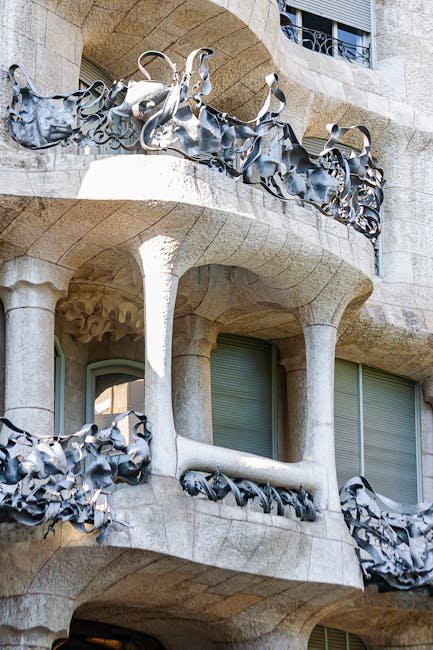
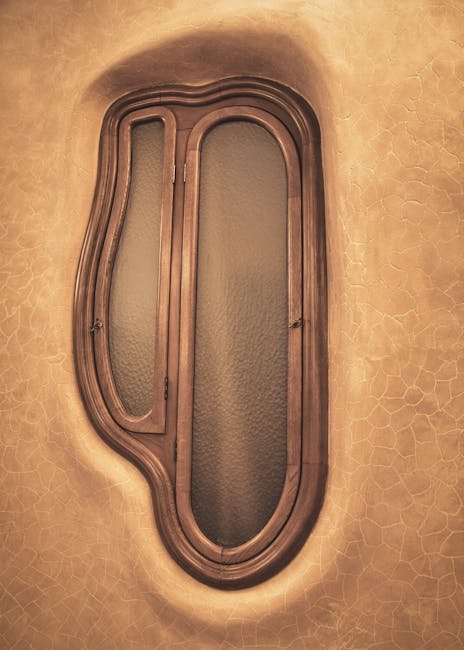
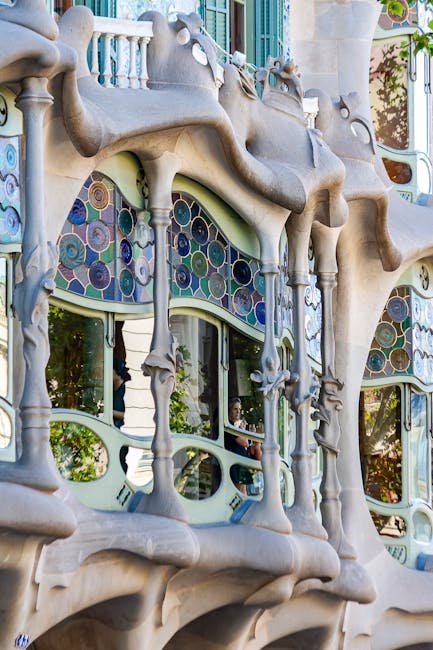
The Casa Mila (1906-1912), known as La Pedrera (the quarry), has a stone facade that undulates like ocean waves. Wrought-iron balconies resemble tangled seaweed. The roof terrace, with its surreal chimneys, is a fantasy landscape of abstract forms.
Gaudi's masterpiece, the Sagrada Familia basilica, occupied the last 43 years of his life. Its interior is a forest of branching columns, and the facades are covered with organic sculpture. Gaudi reversed the Gothic system, using inclined columns and hyperboloid surfaces to eliminate the need for flying buttresses.
Hector Guimard & the Paris Metro
Hector Guimard is best known for his entrances to the Paris Metro (1899-1904), which brought Art Nouveau to the streets of Paris. The green-painted cast-iron canopies, with their sinuous plant-like forms and glowing orange glass panels, became symbols of the city.
Guimard's most important building is the Castel Beranger apartment building in Paris (1895-1898). The entrance features a dramatic asymmetrical composition of iron and glass, and the interior courtyard is a complete Art Nouveau environment. The facade, with its playful combination of brick, stone, and iron, is full of organic detail.
About 140 of Guimard's original 167 Metro entrances survived, though only about 86 remain in their original locations. The style was initially criticized as eccentric but later recognized as one of Art Nouveau's most successful public design projects.
Legacy & Decline
Art Nouveau was remarkably short-lived. By 1910, the style was already in decline, criticized as effeminate and decadent. The geometric rigor of the Vienna Secession and the emerging modernist movement, with its rejection of ornament, pushed Art Nouveau aside.
For decades, Art Nouveau was dismissed as a minor decorative fad. The 1960s and 1970s saw a revival of interest, and today the style is celebrated for its innovation, craftsmanship, and its ambitious attempt to create a complete modern aesthetic.
Art Nouveau's influence can be seen in later organic architecture, from the work of Alvar Aalto to the biomorphic forms of contemporary architects like Zaha Hadid. Its vision of architecture as a total work of art, where every detail contributes to the whole, continues to inspire.
"Art Nouveau drew its inspiration from nature, not from dead styles, seeking to bring the vitality of organic growth into the very fabric of modern urban life."
Art Nouveau Across Europe
While France and Belgium were the birthplace of Art Nouveau, the style spread rapidly across Europe, taking on distinctive national characteristics. In Austria, the Vienna Secession led by Otto Wagner, Josef Hoffmann, and Koloman Moser developed a more geometric, restrained variant that would prove influential on early modernism. Wagner's Majolika House in Vienna demonstrates how floral surface decoration could be applied to a functional urban apartment building.
In Scotland, Charles Rennie Mackintosh developed a highly personal version of Art Nouveau at the Glasgow School of Art, combining Celtic Revival motifs with the sinuous lines of continental Art Nouveau. The school's asymmetrical facade, large studio windows, and dramatic interior spaces made it one of the most innovative buildings of the period. Mackintosh's distinctive rose motif and elegant geometric patterns set his work apart from the more organic style of his European contemporaries.
In Catalonia, the Modernisme movement produced not only Gaudi but also architects like Lluis Domenech i Montaner and Josep Puig i Cadafalch. Domenech's Palau de la Musica Catalana in Barcelona, a UNESCO World Heritage site, is an exuberant celebration of Catalan culture, combining Art Nouveau forms with traditional Catalan ceramics and stained glass in a spectacular concert hall designed as a glass-walled pavilion flooded with natural light.
In Italy, the Stile Liberty (named after the London department store) found expression in the work of architects like Giuseppe Sommaruga and Raimondo D'Aronco. The Grand Hotel Campo dei Fiori in Varese and the Palazzo Castiglioni in Milan show Italian Art Nouveau's distinctive combination of structural boldness and decorative richness, often incorporating sculptural figures and elaborate wrought iron.
Art Nouveau Decorative Arts and Crafts
Art Nouveau's influence on decorative arts was as significant as its architectural achievements. The French glassmaker Emile Galle developed innovative techniques in cameo glass, creating vases and lamps with layered floral and landscape designs. His work, along with that of the Daum brothers in Nancy, elevated glassmaking from craft to fine art. Tiffany Studios in New York, led by Louis Comfort Tiffany, produced Favrile glass and leaded glass lamps that became synonymous with Art Nouveau in America.
Jewelry design underwent a radical transformation under Art Nouveau. Rene Lalique, the most celebrated Art Nouveau jeweler, created pieces that broke completely with Victorian conventions. Using enamel, horn, ivory, and semiprecious stones, Lalique designed jewelry inspired by dragonflies, peacocks, snakes, and female figures that were sculptural rather than merely decorative. His work transformed jewelry from a display of wealth into a personal artistic statement.
Art Nouveau furniture design rejected the heavy historicism of Victorian furniture in favor of lighter, more elegant forms inspired by nature. The French designer Louis Majorelle created furniture with flowing plant-like forms carved in exotic woods. In Belgium, Gustave Serrurier-Bovy produced furniture that emphasized structural clarity while maintaining organic decoration. The British architect Charles Rennie Mackintosh designed furniture with elongated, geometric proportions that anticipated modernist design.
The domestic interior was conceived as a total work of art in the Art Nouveau home. Wallpaper, textiles, carpets, and light fixtures were all designed as part of a unified decorative scheme. The Viennese designer Josef Hoffmann, through the Wiener Werkstatte, produced complete interiors where every object, from furniture to cutlery, followed the same design principles. This integrated approach to design established standards for professional interior design that persist today.
Art Nouveau in Architecture Beyond Europe
Art Nouveau found enthusiastic adoption in the United States, particularly through the work of Louis Comfort Tiffany. While Tiffany is best known for his stained glass lamps, his architectural work included the remarkable Tiffany Chapel and the interior of the Mark Twain House in Hartford, Connecticut. The distinctive organic patterns of Tiffany glass became synonymous with American Art Nouveau, though the style remained more limited in architectural application than in Europe.
In Riga, Latvia, Art Nouveau found one of its most concentrated urban expressions. The city center contains over 800 Art Nouveau buildings, the highest concentration in Europe. Architects like Mikhail Eisenstein created facades of extraordinary decorative richness, combining national romantic motifs with the international Art Nouveau vocabulary. Riga's Art Nouveau district, a UNESCO World Heritage site, demonstrates how the style could be adapted to northern European climates and materials.
South America also developed distinctive Art Nouveau traditions. The Palacio de la Exposicion in Lima, Peru, and the Palacio Barolo in Buenos Aires, Argentina, adapted Art Nouveau to local architectural traditions and materials. In Brazil, the Amazon Theatre in Manaus, built during the rubber boom, combines Art Nouveau elements with imported European materials, creating a unique tropical variant of the style that reflected the cultural ambitions of the Amazonian elite.
Enduring Significance
Art Nouveau demonstrated that modern architecture could draw vitality from the natural world rather than from historical precedent. The movement influence extended beyond architecture into graphic design, jewelry, furniture, and glassware. Its emphasis on craftsmanship and organic form continues to resonate with contemporary designers seeking alternatives to purely functionalist approaches.