The Baroque Sensibility
Baroque architecture emerged around 1600 in Rome as a vehicle for Counter-Reformation Catholic expression. Where Renaissance architecture was calm and rational, Baroque was dynamic and emotional. It aimed to overwhelm the viewer with drama, movement, and sensory richness.
The style was driven by the Catholic Church's need to communicate its power and glory in response to Protestant criticism. Baroque churches were designed as theatrical spaces where architecture, painting, sculpture, and light combined to create an overwhelming experience of divine presence.
Key Baroque features include curved walls and facades that seem to move, broken pediments, intertwined columns, illusionistic ceiling frescoes that dissolve the roof, dramatic chiaroscuro (light-shadow contrast), and rich materials including colored marble, gilding, and stucco.
Bernini & Borromini
Gian Lorenzo Bernini (1598-1680) was the defining artist of the Roman Baroque. His work at St. Peter's Basilica, including the enormous bronze baldachin over the altar and the Cathedra Petri (Chair of St. Peter) in the apse, created the quintessential Baroque interior.
Bernini's Sant'Andrea al Quirinale (1658-1670) is a masterpiece of oval-plan church design. The oval shape creates a dynamic, embracing space, and the rich polychrome marble, gilded stucco, and dramatic lighting from concealed sources produce an effect of ecstatic spirituality.
Francesco Borromini (1599-1667), Bernini's rival, developed an even more radical Baroque language. His San Carlo alle Quattro Fontane (1638-1646) has a complex undulating facade and an oval interior of extraordinary spatial complexity. Borromini's architecture seems to be in constant motion.
Baroque Urbanism & Palaces
Baroque urban planning created some of Europe's most spectacular cityscapes. The re-planning of Rome under Pope Sixtus V established the system of radiating avenues connecting major churches and obelisks that gives Rome its Baroque character. Bernini's colonnade at St. Peter's Square (1656-1667) creates a theatrical embrace of the faithful.
Baroque palace architecture reached its apex at Versailles, where the Hall of Mirrors, the Royal Chapel, and the endless enfilade of state rooms established a model for royal display that was copied across Europe. The Palace of Versailles is the ultimate expression of Baroque power architecture.
The Zwinger in Dresden, the Royal Palace of Madrid, and St. Petersburg's Winter Palace all adapted Baroque vocabulary to local traditions. Central Europe, in particular, saw an extraordinary flowering of Baroque palace and church building in the 18th century.
Rococo: The Playful Successor
Rococo emerged in early 18th-century France as a lighter, more playful reaction to the heavy grandeur of Baroque. Where Baroque was about power and drama, Rococo was about pleasure, intimacy, and wit. The style was particularly suited to interior decoration and small-scale domestic architecture.
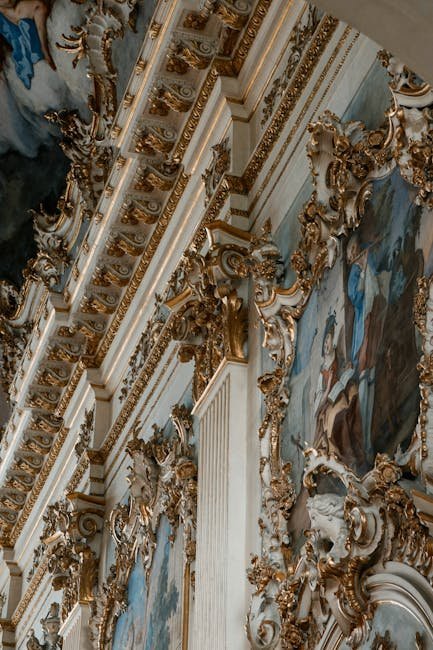
Rococo interiors are characterized by asymmetrical compositions, pastel colors, gilded stucco work, shell-like motifs (rocaille), and painted panels depicting pastoral scenes. The salon, the intimate social space of the French aristocracy, became the laboratory of Rococo design.
The Hotel de Soubise in Paris, with its oval salon decorated by Germain Boffrand, exemplifies Rococo elegance. The Amalienburg hunting lodge near Munich, and the interiors of the Wurzburg Residence's Kaisersaal, show the spread of Rococo to Germany, where it took on a particularly exuberant character.
Legacy & Later Influence
Rococo was rejected by the Neoclassical movement of the late 18th century, which saw it as frivolous and decadent. The rediscovery of Pompeii and Herculaneum, along with the writings of Johann Joachim Winckelmann, promoted a return to what was perceived as the moral purity of classical art.
The 19th century saw revivals of both Baroque and Rococo. The Neo-Baroque style was used for opera houses and theaters, where its theatricality was appropriate. The Paris Opera by Charles Garnier (1861-1875) is the masterpiece of Neo-Baroque, combining Baroque richness with Beaux-Arts planning.
Elements of Baroque and Rococo continue to appear in contemporary architecture. The folded surfaces of Frank Gehry's Guggenheim Bilbao, the dramatic interiors of Zaha Hadid's buildings, and the playful historicism of Michael Graves's work all echo aspects of the Baroque spirit.
"Baroque architecture is the art of the infinite made visible, where boundaries dissolve, surfaces move, and the solid world seems to melt into light and color."
Baroque Theaters and Music Rooms
Baroque architecture found one of its most perfect expressions in theater and music room design. The development of opera in the early 17th century created demand for buildings that could accommodate elaborate stage machinery, large orchestras, and aristocratic audiences. The Teatro San Cassiano in Venice, opened in 1637, established the horseshoe-shaped auditorium with tiers of boxes, a form that would dominate theater design for centuries.
The Baroque theater was not merely a venue but a work of art in itself. Every surface was decorated with gilded stucco, frescoed ceilings, and rich textiles. The stage was designed for spectacular effects: flying machines, trap doors, elaborate scene changes, and complex lighting. Composers like Monteverdi and later Handel benefited from these architectural spaces designed specifically for dramatic musical performance.
In Germany and Austria, Baroque theater design reached its zenith at venues like the Margravial Opera House in Bayreuth, a UNESCO World Heritage site. Its wooden interior, designed by Giuseppe Galli Bibiena, creates an illusionistic space where the boundaries between stage and audience dissolve. The Cuvillies Theater in Munich, though smaller, achieves a similar effect with its cascading tiers of gilded boxes and elaborate stucco ornamentation.
The Baroque tradition of theatrical space continues to influence modern concert hall design. The golden hall of the Musikverein in Vienna, built in 1870 in a Neo-Baroque style, remains one of the world's most acoustically perfect spaces. Its shoebox shape, with its high ceiling, narrow proportions, and layered ornament, creates the rich, warm sound that defines the Viennese orchestral tradition.
Baroque Churches Across Europe
The Baroque church design pioneered in Rome spread rapidly across Europe, adapting to local traditions and materials. In Bavaria and Austria, architects like Johann Michael Fischer and the Asam brothers created spectacular pilgrimage churches that combined Italian Baroque drama with German decorative exuberance. The Wieskirche in Bavaria, a UNESCO World Heritage site, is a masterpiece of Rococo design where architecture, stucco, fresco, and light combine in an overwhelming experience of celestial glory.
In Spain and Latin America, the Spanish Colonial Baroque developed an extraordinarily elaborate style named after the Churriguera family of architects. The facade of the Santiago de Compostela Cathedral and the Sagrario Metropolitano in Mexico City are covered with intricate sculptural decoration that seems to dissolve the building surface into a tapestry of ornament. This style spread throughout the Spanish Empire, creating a distinctive Baroque vocabulary that merged European forms with indigenous American craftsmanship.
Portuguese Baroque developed its own distinctive character, culminating in the monumental Palace of Mafra and the exuberant gold-covered interiors of churches like Sao Francisco in Salvador, Brazil. The Portuguese Rococo used gilded woodwork to create interiors of extraordinary richness and warmth that differ markedly from the cooler stone and stucco of Italian Baroque.
The Church of St. Nicholas in Prague and St. Peter's Church in Vienna represent the Central European Baroque at its most accomplished. These buildings demonstrate how Baroque architects manipulated space and light to create emotional impact. The oval plan, the dramatic placement of altars, and the theatrical use of natural and artificial light in these churches create a sensory experience that continues to move visitors centuries after their construction.
Baroque and Rococo Furniture and Decorative Arts
Baroque furniture was as dramatic as the architecture it furnished. Massive cabinets, elaborate console tables with gilded carving, and monumental mirrors with intricately carved frames defined the Baroque interior. The French cabinetmaker Andre-Charles Boulle perfected the technique of marquetry using tortoiseshell, brass, pewter, and exotic woods, creating furniture of extraordinary richness that became the standard for European royal courts.
Rococo furniture, in contrast, was smaller, more intimate, and designed for comfort and social interaction. The bergere armchair with its upholstered sides, the chaise longue, and the delicate writing desk (bonheur du jour) were Rococo inventions that reflected the more informal social life of the 18th-century French aristocracy. Master cabinetmakers like Jean-Henri Riesener and Bernard van Risenburgh created pieces of extraordinary technical refinement, using exotic woods, gilt bronze mounts, and Sevres porcelain plaques.
The Rococo interior was unified through the use of boiseries, carved wooden wall panels painted in soft colors with gilded highlights. These panels created continuous decorative surfaces that integrated doors, windows, and mirrors into the room's overall composition. The Hotel de Soubise in Paris retains the most complete example of Rococo boiseries, a spectacular ensemble of carved panels, painted ceilings, and gilded decoration that represents the style at its most refined.
The Baroque Sensibility
Baroque architecture emerged around 1600 in Rome as a vehicle for Counter-Reformation Catholic expression. Where Renaissance architecture was calm and rational, Baroque was dynamic and emotional. It aimed to overwhelm the viewer with drama, movement, and sensory richness.
The style was driven by the Catholic Church's need to communicate its power and glory in response to Protestant criticism. Baroque churches were designed as theatrical spaces where architecture, painting, sculpture, and light combined to create an overwhelming experience of divine presence.
Key Baroque features include curved walls and facades that seem to move, broken pediments, intertwined columns, illusionistic ceiling frescoes that dissolve the roof, dramatic chiaroscuro (light-shadow contrast), and rich materials including colored marble, gilding, and stucco.
Bernini & Borromini
Gian Lorenzo Bernini (1598-1680) was the defining artist of the Roman Baroque. His work at St. Peter's Basilica, including the enormous bronze baldachin over the altar and the Cathedra Petri (Chair of St. Peter) in the apse, created the quintessential Baroque interior.
Bernini's Sant'Andrea al Quirinale (1658-1670) is a masterpiece of oval-plan church design. The oval shape creates a dynamic, embracing space, and the rich polychrome marble, gilded stucco, and dramatic lighting from concealed sources produce an effect of ecstatic spirituality.
Francesco Borromini (1599-1667), Bernini's rival, developed an even more radical Baroque language. His San Carlo alle Quattro Fontane (1638-1646) has a complex undulating facade and an oval interior of extraordinary spatial complexity. Borromini's architecture seems to be in constant motion.
Baroque Urbanism & Palaces
Baroque urban planning created some of Europe's most spectacular cityscapes. The re-planning of Rome under Pope Sixtus V established the system of radiating avenues connecting major churches and obelisks that gives Rome its Baroque character. Bernini's colonnade at St. Peter's Square (1656-1667) creates a theatrical embrace of the faithful.
Baroque palace architecture reached its apex at Versailles, where the Hall of Mirrors, the Royal Chapel, and the endless enfilade of state rooms established a model for royal display that was copied across Europe. The Palace of Versailles is the ultimate expression of Baroque power architecture.
The Zwinger in Dresden, the Royal Palace of Madrid, and St. Petersburg's Winter Palace all adapted Baroque vocabulary to local traditions. Central Europe, in particular, saw an extraordinary flowering of Baroque palace and church building in the 18th century.
Rococo: The Playful Successor
Rococo emerged in early 18th-century France as a lighter, more playful reaction to the heavy grandeur of Baroque. Where Baroque was about power and drama, Rococo was about pleasure, intimacy, and wit. The style was particularly suited to interior decoration and small-scale domestic architecture.
Rococo interiors are characterized by asymmetrical compositions, pastel colors, gilded stucco work, shell-like motifs (rocaille), and painted panels depicting pastoral scenes. The salon, the intimate social space of the French aristocracy, became the laboratory of Rococo design.
The Hotel de Soubise in Paris, with its oval salon decorated by Germain Boffrand, exemplifies Rococo elegance. The Amalienburg hunting lodge near Munich, and the interiors of the Wurzburg Residence's Kaisersaal, show the spread of Rococo to Germany, where it took on a particularly exuberant character.
Legacy & Later Influence
Rococo was rejected by the Neoclassical movement of the late 18th century, which saw it as frivolous and decadent. The rediscovery of Pompeii and Herculaneum, along with the writings of Johann Joachim Winckelmann, promoted a return to what was perceived as the moral purity of classical art.
The 19th century saw revivals of both Baroque and Rococo. The Neo-Baroque style was used for opera houses and theaters, where its theatricality was appropriate. The Paris Opera by Charles Garnier (1861-1875) is the masterpiece of Neo-Baroque, combining Baroque richness with Beaux-Arts planning.
Elements of Baroque and Rococo continue to appear in contemporary architecture. The folded surfaces of Frank Gehry's Guggenheim Bilbao, the dramatic interiors of Zaha Hadid's buildings, and the playful historicism of Michael Graves's work all echo aspects of the Baroque spirit.
"Baroque architecture is the art of the infinite made visible, where boundaries dissolve, surfaces move, and the solid world seems to melt into light and color."
Baroque Theaters and Music Rooms
Baroque architecture found one of its most perfect expressions in theater and music room design. The development of opera in the early 17th century created demand for buildings that could accommodate elaborate stage machinery, large orchestras, and aristocratic audiences. The Teatro San Cassiano in Venice, opened in 1637, established the horseshoe-shaped auditorium with tiers of boxes, a form that would dominate theater design for centuries.
The Baroque theater was not merely a venue but a work of art in itself. Every surface was decorated with gilded stucco, frescoed ceilings, and rich textiles. The stage was designed for spectacular effects: flying machines, trap doors, elaborate scene changes, and complex lighting. Composers like Monteverdi and later Handel benefited from these architectural spaces designed specifically for dramatic musical performance.
In Germany and Austria, Baroque theater design reached its zenith at venues like the Margravial Opera House in Bayreuth, a UNESCO World Heritage site. Its wooden interior, designed by Giuseppe Galli Bibiena, creates an illusionistic space where the boundaries between stage and audience dissolve. The Cuvillies Theater in Munich, though smaller, achieves a similar effect with its cascading tiers of gilded boxes and elaborate stucco ornamentation.
The Baroque tradition of theatrical space continues to influence modern concert hall design. The golden hall of the Musikverein in Vienna, built in 1870 in a Neo-Baroque style, remains one of the world's most acoustically perfect spaces. Its shoebox shape, with its high ceiling, narrow proportions, and layered ornament, creates the rich, warm sound that defines the Viennese orchestral tradition.
Baroque Churches Across Europe
The Baroque church design pioneered in Rome spread rapidly across Europe, adapting to local traditions and materials. In Bavaria and Austria, architects like Johann Michael Fischer and the Asam brothers created spectacular pilgrimage churches that combined Italian Baroque drama with German decorative exuberance. The Wieskirche in Bavaria, a UNESCO World Heritage site, is a masterpiece of Rococo design where architecture, stucco, fresco, and light combine in an overwhelming experience of celestial glory.
In Spain and Latin America, the Spanish Colonial Baroque developed an extraordinarily elaborate style named after the Churriguera family of architects. The facade of the Santiago de Compostela Cathedral and the Sagrario Metropolitano in Mexico City are covered with intricate sculptural decoration that seems to dissolve the building surface into a tapestry of ornament. This style spread throughout the Spanish Empire, creating a distinctive Baroque vocabulary that merged European forms with indigenous American craftsmanship.
Portuguese Baroque developed its own distinctive character, culminating in the monumental Palace of Mafra and the exuberant gold-covered interiors of churches like Sao Francisco in Salvador, Brazil. The Portuguese Rococo used gilded woodwork to create interiors of extraordinary richness and warmth that differ markedly from the cooler stone and stucco of Italian Baroque.
The Church of St. Nicholas in Prague and St. Peter's Church in Vienna represent the Central European Baroque at its most accomplished. These buildings demonstrate how Baroque architects manipulated space and light to create emotional impact. The oval plan, the dramatic placement of altars, and the theatrical use of natural and artificial light in these churches create a sensory experience that continues to move visitors centuries after their construction.
Baroque and Rococo Furniture and Decorative Arts
Baroque furniture was as dramatic as the architecture it furnished. Massive cabinets, elaborate console tables with gilded carving, and monumental mirrors with intricately carved frames defined the Baroque interior. The French cabinetmaker Andre-Charles Boulle perfected the technique of marquetry using tortoiseshell, brass, pewter, and exotic woods, creating furniture of extraordinary richness that became the standard for European royal courts.
Rococo furniture, in contrast, was smaller, more intimate, and designed for comfort and social interaction. The bergere armchair with its upholstered sides, the chaise longue, and the delicate writing desk (bonheur du jour) were Rococo inventions that reflected the more informal social life of the 18th-century French aristocracy. Master cabinetmakers like Jean-Henri Riesener and Bernard van Risenburgh created pieces of extraordinary technical refinement, using exotic woods, gilt bronze mounts, and Sevres porcelain plaques.
The Rococo interior was unified through the use of boiseries, carved wooden wall panels painted in soft colors with gilded highlights. These panels created continuous decorative surfaces that integrated doors, windows, and mirrors into the room's overall composition. The Hotel de Soubise in Paris retains the most complete example of Rococo boiseries, a spectacular ensemble of carved panels, painted ceilings, and gilded decoration that represents the style at its most refined.
Baroque and Rococo Across the European Capitals
The Baroque style spread across Europe through a combination of political ambition, religious competition, and artistic pilgrimage. In Vienna, the Baroque architecture of Fischer von Erlach and Johann Bernhard Fischer celebrated the Habsburg Empire's power through monumental buildings like Schonbrunn Palace and the Karlskirche, whose dramatic dome and Trajan-like columns synthesized imperial Roman and Catholic triumphalist imagery. In St. Petersburg, Bartolomeo Rastrelli's Winter Palace and Catherine Palace brought the Baroque to Russia with a distinctive northern exuberance, using turquoise and white facades, gilded interiors, and an almost operatic sense of spectacle that matched the ambitions of Peter the Great and Catherine the Great. Each capital adapted Baroque principles to local materials, climates, and political contexts, creating a family of related but distinct national styles.
Further Reading
Learn more about Baroque architecture on Wikipedia and explore broader Western architecture traditions.