The Age of Glamour
Art Deco, named after the 1925 Exposition Internationale des Arts Decoratifs et Industriels Modernes in Paris, was the defining style of the Jazz Age. It represented luxury, glamour, and confidence in modernity, combining geometric abstraction with rich materials and fine craftsmanship.
Art Deco was not a single style but a synthesis of diverse influences: Cubism and Futurism in painting, the Ballets Russes in dance, African and Aztec art, the discovery of Tutankhamun's tomb (Egyptian motifs became hugely popular), and the machine aesthetic of the early 20th century.
The style embodied the spirit of the Roaring Twenties: optimism, technological progress, and a break with the past. Its zigzags, sunbursts, and streamlined forms spoke of speed, energy, and modernity. Even the Great Depression could not fully extinguish the Deco love of elegance.
Key Features
Art Deco buildings are characterized by geometric ornament: chevrons, zigzags, stepped forms (setbacks), sunbursts, and stylized floral motifs. These patterns appear in stone, metal, glass, and ceramic tile. The overall effect is decorative but disciplined, never naturalistic.
Materials are chosen for their richness and contrast. Stainless steel, aluminum, chrome, colored glass, enamel, polished stone, and exotic woods are used in combination. Color schemes range from black and silver to vibrant combinations of turquoise, coral, gold, and deep blue.
The vertical emphasis of skyscrapers is often accentuated with vertical ribs, piers, and setbacks. At street level, entrances are elaborate compositions of marble, metal, and glass. Lobbies are designed as complete decorative environments, often with murals, mosaics, and elaborate lighting.
The Chrysler Building
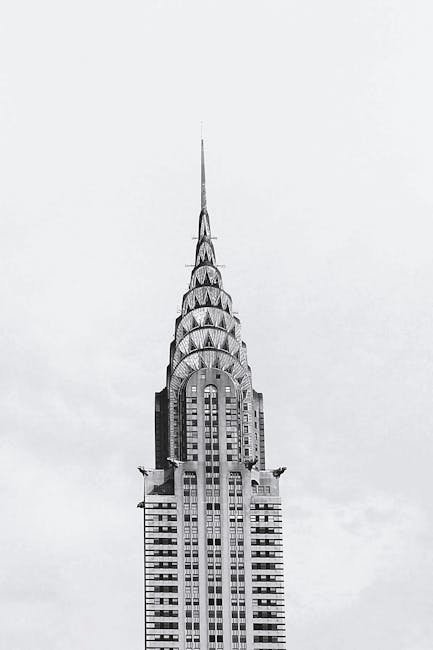
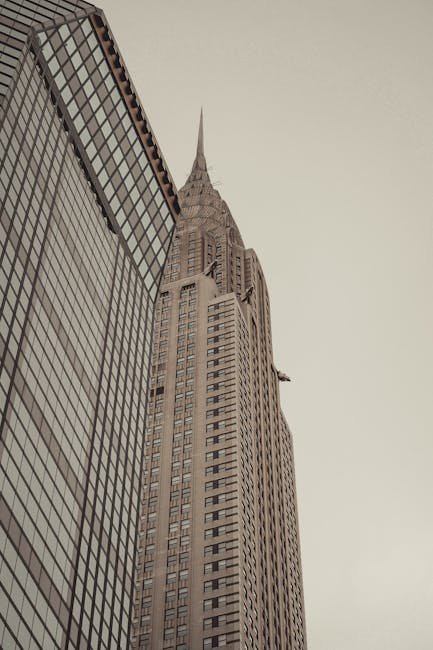
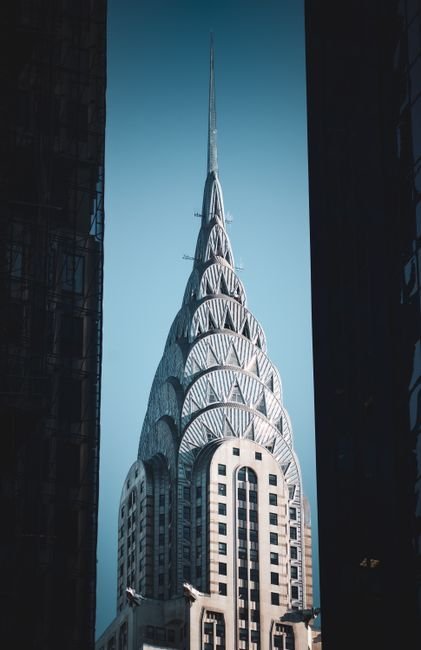
The Chrysler Building in New York (1928-1930) is the quintessential Art Deco skyscraper. Designed by William Van Alen, it was briefly the world's tallest building. Its stainless steel crown, with triangular vaulted arches and a spire, is one of the most recognizable building tops ever designed.
The building's ornament celebrates the automobile industry. Eagle gargoyles (modeled after Chrysler hood ornaments), hubcap motifs, and radiator-cap inspired details decorate the exterior. The lobby is a masterpiece of Deco design, with African red marble, chrome-plated elevator doors, and a ceiling mural depicting transportation and labor.
The Chrysler Building demonstrated that skyscrapers could be more than functional: they could be works of art. Its crown, designed to catch sunlight and reflect it at every hour, was intended as a spectacular urban gesture, a 'send-off' to the sky.
Miami Beach & Tropical Deco
Miami Beach developed a unique variant of Art Deco known as Tropical Deco or MiMo (Miami Modern). Painted in pastel colors, with rounded corners, porthole windows, neon signs, and nautical motifs, Miami's Deco hotels and apartment buildings embody the style's lighter, more playful side.
The Miami Beach Architectural District contains the largest concentration of Art Deco buildings in the world, with over 800 structures dating from 1923 to 1943. The district was saved from demolition by the preservation efforts of Barbara Capitman and the Miami Design Preservation League in the 1970s.
Buildings like the Colony Hotel, the Carlyle Hotel, and the Essex House showcase the Miami Beach approach: streamlined forms, tropical colors, and an open, welcoming character that perfectly suited the resort atmosphere.
Deco's Global Reach & Legacy
Art Deco was a truly international style. In Mumbai, the Marine Drive area contains the second-largest collection of Art Deco buildings after Miami. In Shanghai, the Bund and the French Concession feature Deco buildings that combine Western forms with Chinese motifs.
Napier, New Zealand, rebuilt after a devastating 1931 earthquake, was reconstructed almost entirely in Art Deco. The city's buildings, many designed by architect Louis Hay, showcase the style's adaptability to small-scale commercial and civic architecture.
Art Deco's influence declined after World War II, replaced by the austerity of modernist architecture. However, a resurgence of interest in recent decades has led to the restoration of many Deco buildings and renewed appreciation for the style's craftsmanship, optimism, and urbanity.
"Art Deco was the last great decorative style, a celebration of craftsmanship and modernity that brought joy and elegance to the city streets."
Art Deco Interiors and Furniture
Art Deco interior design was as distinctive as its architecture. Rooms were conceived as total environments, with coordinated color schemes, custom furniture, and integrated lighting. Designers worked alongside architects to ensure every detail, from door handles to ceiling fixtures, followed the Deco aesthetic. This holistic approach made Art Deco one of the first truly integrated design movements of the modern era.
Furniture design emphasized geometric forms, exotic materials, and fine craftsmanship. Emile-Jacques Ruhlmann produced pieces in Macassar ebony and amaranth, inlaid with ivory and mother of pearl. The French designer Paul Follot created furniture that balanced modernist simplicity with traditional decorative richness. Their work elevated furniture from mere utility to sculptural art.
Lighting played a crucial role in Art Deco interiors. Chandeliers and sconces used etched glass, chrome, and alabaster to create sophisticated lighting effects. The Lalique company produced highly sought-after Deco lighting, with frosted glass panels featuring stylized floral and geometric patterns. These fixtures transformed ordinary spaces into glamorous environments that felt modern and luxurious.
American Art Deco interiors were heavily influenced by Hollywood. Movie palaces like Grauman's Chinese Theatre and Radio City Music Hall brought Deco glamour to the masses with lavish lobbies and ornate auditoriums. Department stores, restaurants, and offices across the country adopted similar styling, making Art Deco the defining commercial interior style of the 1930s.
Art Deco in Commercial Architecture
Art Deco found its most expressive commercial application in the movie palaces of the 1920s and 1930s. Theaters like Grauman's Chinese Theatre in Hollywood, the Fox Theatre in Atlanta, and the Paramount Theatre in Oakland were designed as fantasy environments where audiences could escape the hardships of the Great Depression. These buildings used elaborate Art Deco and exotic revival ornament, dramatic marquees, and opulent lobbies to create a sense of occasion around the movie-going experience.
Streamline Moderne, a later phase of Art Deco that emerged in the 1930s, emphasized aerodynamic forms and horizontal lines. This style was particularly suited to transportation architecture: airports, train stations, and bus terminals. The Miami Beach Architectural District and the Normandie Hotel in San Juan, Puerto Rico, exemplify how Streamline Moderne adapted Deco principles to a more restrained, machine-age aesthetic that celebrated speed and efficiency.
Art Deco diners and roadside architecture brought the style to everyday American life. The classic stainless steel diner, with its sleek lines, neon signage, and chrome accents, was a distinctly American interpretation of Art Deco design. Worcester Lunch Car Company and the O'Mahony Company produced prefabricated diners that brought Deco glamour to small towns and city neighborhoods across the country, making modern design accessible to ordinary Americans.
The restoration of historic Art Deco buildings has become an important preservation movement. Organizations like the Art Deco Society and the Miami Design Preservation League work to protect threatened Deco buildings. The recent restoration of the Eastern Columbia Building in Los Angeles and the Buffalo City Hall in New York demonstrate how Art Deco buildings can be adapted for modern use while preserving their original character and craftsmanship.
Art Deco Lighting and Interior Details
Art Deco lighting fixtures were masterpieces of design in their own right. Chandeliers, sconces, and table lamps used etched glass, chrome, bronze, and alabaster to create sophisticated illumination effects. The French designer Edgar Brandt created wrought-iron lighting and screens of extraordinary artistry, while the Lalique company produced glass panels that diffused light through frosted floral and geometric patterns. These fixtures were not afterthoughts but integral elements of the Deco interior, carefully coordinated with the overall design scheme.
The color palette of Art Deco evolved significantly over its two decades of dominance. The early 1920s favored rich jewel tones: emerald green, ruby red, sapphire blue, and abundant gold leaf set against backgrounds of black lacquer, cream, or beige. The later 1930s, influenced by the austerity of the Depression, moved toward more subdued combinations of beige, brown, steel gray, and off-white. This shift reflected broader cultural changes from the exuberance of the Jazz Age to the more serious mood of the Depression era.
Art Deco interior details extended to the smallest elements of a room. Door handles, light switches, radiator grilles, and ventilation covers were all designed as opportunities for decorative expression. Geometric patterns appeared in parquet flooring, marble terrazzo, and custom carpets. The cumulative effect was of a completely designed environment where every surface and object contributed to a unified aesthetic vision.
The Age of Glamour
Art Deco, named after the 1925 Exposition Internationale des Arts Decoratifs et Industriels Modernes in Paris, was the defining style of the Jazz Age. It represented luxury, glamour, and confidence in modernity, combining geometric abstraction with rich materials and fine craftsmanship.
Art Deco was not a single style but a synthesis of diverse influences: Cubism and Futurism in painting, the Ballets Russes in dance, African and Aztec art, the discovery of Tutankhamun's tomb (Egyptian motifs became hugely popular), and the machine aesthetic of the early 20th century.
The style embodied the spirit of the Roaring Twenties: optimism, technological progress, and a break with the past. Its zigzags, sunbursts, and streamlined forms spoke of speed, energy, and modernity. Even the Great Depression could not fully extinguish the Deco love of elegance.
Key Features
Art Deco buildings are characterized by geometric ornament: chevrons, zigzags, stepped forms (setbacks), sunbursts, and stylized floral motifs. These patterns appear in stone, metal, glass, and ceramic tile. The overall effect is decorative but disciplined, never naturalistic.
Materials are chosen for their richness and contrast. Stainless steel, aluminum, chrome, colored glass, enamel, polished stone, and exotic woods are used in combination. Color schemes range from black and silver to vibrant combinations of turquoise, coral, gold, and deep blue.
The vertical emphasis of skyscrapers is often accentuated with vertical ribs, piers, and setbacks. At street level, entrances are elaborate compositions of marble, metal, and glass. Lobbies are designed as complete decorative environments, often with murals, mosaics, and elaborate lighting.
The Chrysler Building
The Chrysler Building in New York (1928-1930) is the quintessential Art Deco skyscraper. Designed by William Van Alen, it was briefly the world's tallest building. Its stainless steel crown, with triangular vaulted arches and a spire, is one of the most recognizable building tops ever designed.
The building's ornament celebrates the automobile industry. Eagle gargoyles (modeled after Chrysler hood ornaments), hubcap motifs, and radiator-cap inspired details decorate the exterior. The lobby is a masterpiece of Deco design, with African red marble, chrome-plated elevator doors, and a ceiling mural depicting transportation and labor.
The Chrysler Building demonstrated that skyscrapers could be more than functional: they could be works of art. Its crown, designed to catch sunlight and reflect it at every hour, was intended as a spectacular urban gesture, a 'send-off' to the sky.
Miami Beach & Tropical Deco
Miami Beach developed a unique variant of Art Deco known as Tropical Deco or MiMo (Miami Modern). Painted in pastel colors, with rounded corners, porthole windows, neon signs, and nautical motifs, Miami's Deco hotels and apartment buildings embody the style's lighter, more playful side.
The Miami Beach Architectural District contains the largest concentration of Art Deco buildings in the world, with over 800 structures dating from 1923 to 1943. The district was saved from demolition by the preservation efforts of Barbara Capitman and the Miami Design Preservation League in the 1970s.
Buildings like the Colony Hotel, the Carlyle Hotel, and the Essex House showcase the Miami Beach approach: streamlined forms, tropical colors, and an open, welcoming character that perfectly suited the resort atmosphere.
Deco's Global Reach & Legacy
Art Deco was a truly international style. In Mumbai, the Marine Drive area contains the second-largest collection of Art Deco buildings after Miami. In Shanghai, the Bund and the French Concession feature Deco buildings that combine Western forms with Chinese motifs.
Napier, New Zealand, rebuilt after a devastating 1931 earthquake, was reconstructed almost entirely in Art Deco. The city's buildings, many designed by architect Louis Hay, showcase the style's adaptability to small-scale commercial and civic architecture.
Art Deco's influence declined after World War II, replaced by the austerity of modernist architecture. However, a resurgence of interest in recent decades has led to the restoration of many Deco buildings and renewed appreciation for the style's craftsmanship, optimism, and urbanity.
"Art Deco was the last great decorative style, a celebration of craftsmanship and modernity that brought joy and elegance to the city streets."
Art Deco Interiors and Furniture
Art Deco interior design was as distinctive as its architecture. Rooms were conceived as total environments, with coordinated color schemes, custom furniture, and integrated lighting. Designers worked alongside architects to ensure every detail, from door handles to ceiling fixtures, followed the Deco aesthetic. This holistic approach made Art Deco one of the first truly integrated design movements of the modern era.
Furniture design emphasized geometric forms, exotic materials, and fine craftsmanship. Emile-Jacques Ruhlmann produced pieces in Macassar ebony and amaranth, inlaid with ivory and mother of pearl. The French designer Paul Follot created furniture that balanced modernist simplicity with traditional decorative richness. Their work elevated furniture from mere utility to sculptural art.
Lighting played a crucial role in Art Deco interiors. Chandeliers and sconces used etched glass, chrome, and alabaster to create sophisticated lighting effects. The Lalique company produced highly sought-after Deco lighting, with frosted glass panels featuring stylized floral and geometric patterns. These fixtures transformed ordinary spaces into glamorous environments that felt modern and luxurious.
American Art Deco interiors were heavily influenced by Hollywood. Movie palaces like Grauman's Chinese Theatre and Radio City Music Hall brought Deco glamour to the masses with lavish lobbies and ornate auditoriums. Department stores, restaurants, and offices across the country adopted similar styling, making Art Deco the defining commercial interior style of the 1930s.
Art Deco in Commercial Architecture
Art Deco found its most expressive commercial application in the movie palaces of the 1920s and 1930s. Theaters like Grauman's Chinese Theatre in Hollywood, the Fox Theatre in Atlanta, and the Paramount Theatre in Oakland were designed as fantasy environments where audiences could escape the hardships of the Great Depression. These buildings used elaborate Art Deco and exotic revival ornament, dramatic marquees, and opulent lobbies to create a sense of occasion around the movie-going experience.
Streamline Moderne, a later phase of Art Deco that emerged in the 1930s, emphasized aerodynamic forms and horizontal lines. This style was particularly suited to transportation architecture: airports, train stations, and bus terminals. The Miami Beach Architectural District and the Normandie Hotel in San Juan, Puerto Rico, exemplify how Streamline Moderne adapted Deco principles to a more restrained, machine-age aesthetic that celebrated speed and efficiency.
Art Deco diners and roadside architecture brought the style to everyday American life. The classic stainless steel diner, with its sleek lines, neon signage, and chrome accents, was a distinctly American interpretation of Art Deco design. Worcester Lunch Car Company and the O'Mahony Company produced prefabricated diners that brought Deco glamour to small towns and city neighborhoods across the country, making modern design accessible to ordinary Americans.
The restoration of historic Art Deco buildings has become an important preservation movement. Organizations like the Art Deco Society and the Miami Design Preservation League work to protect threatened Deco buildings. The recent restoration of the Eastern Columbia Building in Los Angeles and the Buffalo City Hall in New York demonstrate how Art Deco buildings can be adapted for modern use while preserving their original character and craftsmanship.
Art Deco Lighting and Interior Details
Art Deco lighting fixtures were masterpieces of design in their own right. Chandeliers, sconces, and table lamps used etched glass, chrome, bronze, and alabaster to create sophisticated illumination effects. The French designer Edgar Brandt created wrought-iron lighting and screens of extraordinary artistry, while the Lalique company produced glass panels that diffused light through frosted floral and geometric patterns. These fixtures were not afterthoughts but integral elements of the Deco interior, carefully coordinated with the overall design scheme.
The color palette of Art Deco evolved significantly over its two decades of dominance. The early 1920s favored rich jewel tones: emerald green, ruby red, sapphire blue, and abundant gold leaf set against backgrounds of black lacquer, cream, or beige. The later 1930s, influenced by the austerity of the Depression, moved toward more subdued combinations of beige, brown, steel gray, and off-white. This shift reflected broader cultural changes from the exuberance of the Jazz Age to the more serious mood of the Depression era.
Art Deco interior details extended to the smallest elements of a room. Door handles, light switches, radiator grilles, and ventilation covers were all designed as opportunities for decorative expression. Geometric patterns appeared in parquet flooring, marble terrazzo, and custom carpets. The cumulative effect was of a completely designed environment where every surface and object contributed to a unified aesthetic vision.
Art Deco's Global Reach and Legacy
Art Deco's influence spread far beyond its European and American origins, reaching virtually every continent and adapting to local traditions in remarkable ways. In India, the Art Deco buildings of Mumbai's Marine Drive and the New India Assurance Building blended geometric ornamentation with Mughal-inspired motifs, creating a distinctive Indo-Deco style. In Latin America, architects like Francisco Salamone in Argentina and Rino Levi in Brazil applied Art Deco's streamlined forms to public buildings, cinemas, and commercial structures, often incorporating indigenous patterns and vibrant colors. This global diffusion demonstrated Art Deco's remarkable adaptability — unlike earlier styles that imposed rigid formulas, Art Deco provided a flexible vocabulary that could absorb regional influences while maintaining its essential character of geometric elegance and modern optimism.
Further Reading
Learn more about Art Deco on Wikipedia and explore broader Western architecture traditions.